








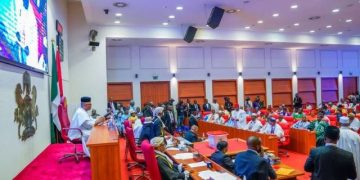

































WorldStage— The Speaker of Nigeria’s House of Representatives Rt. Hon. Abbas Tajudeen, has said the Federal Government is committed to free, fair, and credible general elections in 2027, adding that the House is providing legislative backing to the democratic process.
He made this known when hosting a delegation from the International Republican Institute (IRI) on a courtesy call at his office in Abuja.
He was represented by the House Leader, Prof. Julius Ihonvbere.
The IRI says it is “supporting political freedom and democratic dignity in more than 100 countries.” Led by the IRI President, Dan Twining, the delegation had a former Assistant Secretary for African Affairs, Bush Administration, Jendayi Frazier; African Regional Director for IRI, Jenai Cox; Deputy Director, West and Central Africa for NDI, Sophia Moestrup; West Africa Regional Program Director for IRI, Sentell Barnes; IRI Senior Governance Advisor, Sunday Alao; and Long-term Election Analyst, Austin Akers, as members.
The Speaker noted how President Bola Ahmed Tinubu, GCFR, called to congratulate Governor Ademola Adeleke, who was candidate of the opposition Accord Party in the recent governorship election in Osun State, for winning the poll even before his victory speech.
Speaking through Prof. Ihonvbere, the Speaker noted that the election has been widely acclaimed to be successful despite initial fears.
“It simply shows that our democracy is growing,” Speaker Abbas said while commending the Independent National Electoral Commission (INEC) for supervising the exercise.
While the Speaker described the reported violence before the election as painful, he expressed hope that such would not be recorded before the 2027 general elections.
“I really believe it is a work in progress,” he said, adding that “we are not there yet, but we have made a lot of progress.”
The Speaker emphasised that electoral reforms are still ongoing, highlighting that implementation of regulatory laws is another hurdle to be crossed, saying, “We have to deal with the human factors.”
While speaking for the direct primary mode, Speaker Abbas said it allows the emergence of popular candidates. “Let’s allow every card-carrying member of a political party to participate in a primary,” he said, citing the case of a godfather or moneybag who can afford to sponsor an aspirant and mobilise delegates to their candidate for an election.
The Speaker also noted how communities rotate legislative seats to address issues of local representation, which often leads to high turnover of lawmakers at the parliament.
“We have tried as much as possible to strengthen INEC,” the Speaker said while stating that, “There are still a lot of issues concerning democratising political space. We are doing our best here. We are doing everything possible to strengthen institutions.”
Speaker Abbas also decried low representation of women in the parliament, saying there are only 15 women among the 360 members of the House and four among the 109 senators.
“In the House, we are very strong in pushing for what is called ‘special seats for women,’” he said.
The Speaker stressed the need to democratise the political space to create equal opportunities in politics and participation in government.
Responding to a question on security ahead of the general elections, the Speaker said safety is part of the major considerations ahead of the polls. “The security situation as of today has improved significantly as compared to three years ago,” he said.
On the public’s accessibility to the parliament, Speaker Abbas stated that “this House of Reps particularly has been more open to the public and civil society than any before it.”
He listed a series of periodic events and stakeholder engagements organised by the House as well as several CSOs working with the legislature as technical partners.
Speaker Abbas called for more public education on democracy and its institutions, especially the National Assembly. He decried the misconception about the parliament, saying, “In the eyes of the public, the National Assembly is working when it is in conflict with the Executive arm of the government.”
He, however, stated that Nigeria has achieved more with the cooperation and collaboration between the Legislature and the Executive. “We are getting better results,” he declared.
Earlier, the IRI President, Dan Twining, said the Institute has observed about 300 elections around the world and has been monitoring polls in Nigeria since 1999.
Twining said the visit to the House was part of IRI’s engagement with key Nigerian stakeholders to assess readiness for the forthcoming elections.
The IRI President noted that the Institute observed the primaries conducted by political parties and how candidates for the elections emerged, disclosing that the body had earlier met with the National Chairman of INEC, Prof. Joash Amupitan, SAN, who “welcomed us to Africa’s largest democracy.”
Twining disclosed that the IRI would soon address a press conference based on information from stakeholders, observations made, and its recommendations, with another pre-election press conference to be held later in November.