




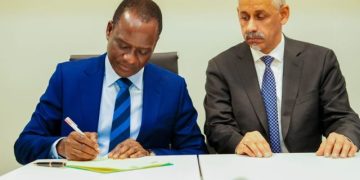










































UBEC Executive Secretary, Dr Aisha Garba and state chairmen of the Commission after the first session of the HOPE-EDU PROGRAMME READINESS in Abuja today, October 13, 2026.
WorldStage— The Universal Basic Education Commission (UBEC) Tuesday, October 13, 2026 commenced a critical two-day strategic review and sensitization meeting with the chairmen of all 36 State Universal Basic Education Boards (SUBEBs) and the Federal Capital Territory (FCT).
The high-profile gathering focuses entirely on evaluating sub-national infrastructure and systemic readiness for the immediate implementation of the Human Capital Opportunities for Prosperity and Equity in Education (HOPE-EDU) Programme.
The landmark $552.18 million initiative, co-financed by a $500 million World Bank International Development Association (IDA) credit and a $52.2 million Global Partnership for Education (GPE) grant, represents the federal government’s flagship reform under the Renewed Hope Agenda.
Operating on a Program-for-Results (PforR) model, funding disbursements under HOPE-EDU are strictly tied to verified operational milestones, making state readiness non-negotiable.
Addressing the assembly in Abuja, the Executive Secretary of UBEC, Dr. Aisha Garba, emphasized that the success of the multi-million dollar intervention rests heavily on sub-national execution.
“This readiness meeting is not a formality; it is the ultimate gateway to unlocking the initial phase of program funding. The future of millions of Nigerian children depends on how meticulously our SUBEBs align their operational frameworks with international standard benchmarks,” Dr. Garba stated.
The HOPE-EDU program targets massive structural deficits across Nigeria’s basic education landscape.
Over its implementation lifecycle, the initiative intends to direct assistance to over 29 million public primary school students; provide professional development and capacity building for 500,000 public school teachers; deliver 13,000 newly constructed or rehabilitated classrooms nationwide; and systematically reintegrate millions of out-of-school children back into formal education systems.
A major focus of the two-day engagement is a meticulous audit of state plans concerning the Structured Pedagogy Package (SPP).
This evidence-based framework aims to drastically reduce learning poverty by building teaching capacity specifically around foundational literacy and numeracy outcomes.
Furthermore, UBEC officials are reviewing state implementation of the Book Supply Chain and Track and Trace System.
This digital system, according to the Commission, is designed to introduce absolute transparency and corporate accountability into the distribution of learning materials, ensuring high-quality resources reach the correct pupils and schools without diversion.
To reinforce transparency, UBEC is matching the HOPE-EDU rollout with the newly deployed Basic Education Action Plan Management System (BEAPMS).
State chairmen are being trained to utilize this digital platform to conduct precise, individual school-level gap assessments.
Moving forward, the Commission stated, states must present unified data regarding local school needs before further federal interventions or financial drawdowns are authorized.
The high-level convergence also serves as the ultimate alignment mission to evaluate technical infrastructure, institutional frameworks, and fiscal compliance metrics required across Nigeria’s 36 states and the Federal Capital Territory.
“HOPE-EDU represents a paradigm shift under President Bola Ahmed Tinubu’s Renewed Hope Agenda. Funding will no longer be distributed based on mere projections. Disbursements are strictly tied to performance. States must demonstrate total administrative and technical readiness to unlock their first-round funding allocations,” Executive Secretary Garba stated.
With the tight verification deadlines set by the international steering committee, SUBEB chairmen have pledged to accelerate localized institutional reforms.
The ongoing two-day engagement concludes tomorrow with a joint resolution detailing the specific compliance timelines for individual states.