
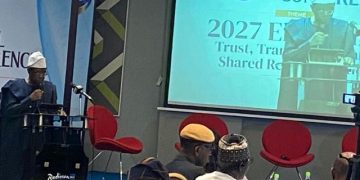





























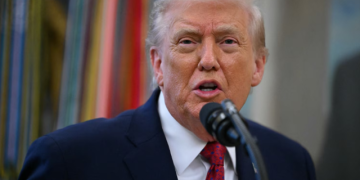












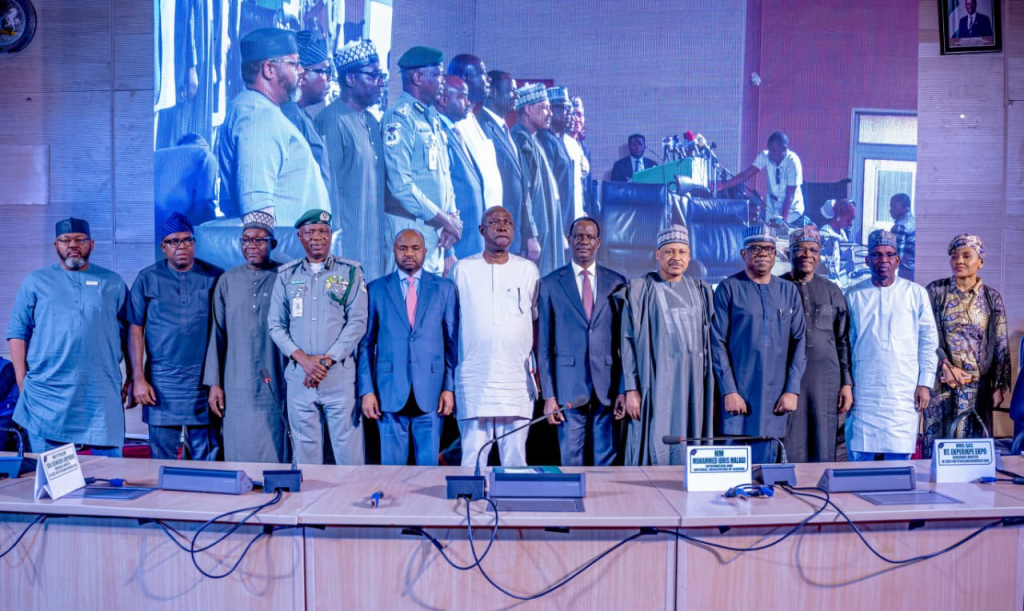
The Minister of Finance and Coordinating Minister of the Economy, Taiwo Oyedele; the Minister of Information and National Orientation, Mohammed Idris, fnipr; the Minister of State for Petroleum Resources (Oil), Senator Heineken Lokpobiri; and key government officials and stakeholders, during a press briefing on Fuel Prices and the Subsidy Question in Abuja.
By Abiodun Folarin
WorldStage— The Federal Government has announced a 30-day petrol discount by NNPC Limited and proposed a ₦1,350-per-litre ceiling on petrol landing and related costs as part of measures to cushion households and businesses from rising fuel prices.
The Minister of Finance and Coordinating Minister of the Economy, Mr. Taiwo Oyedele, announced the measures on Thursday in Abuja, insisting that the package was not a return to fuel subsidy.
According to him, under the arrangement, NNPC Limited will offer the discount on petrol sold at its retail stations, with priority given to public transport operators nationwide.
Oyedele said the government was effectively directing NNPC to sell petrol at cost during the period to provide temporary relief to consumers.
He noted that the government also plans to introduce a price modulation mechanism to reduce sharp swings in petrol prices.
“We’re introducing price modulation, and I will explain. Home prices should not have to follow every swing in global crude or the exchange rates. The government is negotiating a ceiling of ₦1,350 a litre on the exit and trade or landing costs of petrol to keep home prices stable.
“Where costs rise above the ceiling, refiners and importers will carry the shortfall and recover it later, when crude prices or exchange rates allow, without breaching the ceiling. This is neither a subsidy nor a price control. It is designed to swing prices over time rather than suppressing them.
“The reasoning is simple. ₦1,400 a litre today and ₦1,400 a litre tomorrow is better than ₦1,500 a litre today and ₦1,300 a litre tomorrow. Why? Because volatility itself adds to uncertainty and costs,” he said.
He said the ceiling would be reviewed monthly and adjusted when necessary, with the figures published for transparency.
Crude Supply to Refineries
Oyedele said the government would also introduce forward sales of crude to domestic refineries as production increases and previously committed crude volumes become available.
Oyedele said the arrangement would help shield domestic petrol prices from volatility in the international market.
He described the mechanism as a normal contractual arrangement that would provide greater certainty for domestic refiners and consumers.
Other Measures
The government also announced plans to remove illegal taxes and levies that increase transportation and logistics costs.
Oyedele said the Federal Government was working with states under the new tax laws to rein in road taxes and other levies imposed on transport operators.
He disclosed that some truckers had reported spending as much as ₦700,000 per trip transporting food from northern Nigeria to the south.
Other measures include “increased funding for cash transfers to vulnerable households and subsidised credit for small businesses and consumers,” he said.
The minister also announced plans to accelerate the rollout of compressed natural gas (CNG) and encourage transport operators to pass savings from cheaper fuel to passengers through lower fares.
He said the government was also considering an excess profit tax on operators found to be taking undue advantage of consumers across the energy value chain.
Oyedele said proceeds from the proposed tax would be used to cushion the impact of high energy prices through transport support and vouchers for vulnerable urban minimum-wage earners.
He said the government would also work with the National Assembly to introduce enhanced tax relief for low-income earners under the 2027 Finance Bill.
Another major component of the package is the planned National Strategic Fuel Reserve.
Oyedele said refined petroleum products would be released into the market under clearly defined rules whenever global disruptions or hoarding threatened supply and price stability.
He said the reserve would not be used to control prices or reintroduce subsidy but would help prevent artificial scarcity, discourage market manipulation and reduce price volatility.
The government also plans to cut regulatory costs that contribute to higher business and consumer prices.
Oyedele said heads of relevant ministries, departments and agencies would work with the government to identify and eliminate unnecessary regulatory charges.
The final measure focuses on traffic and logistics management, with traffic agencies expected to improve traffic flow in major urban centres to reduce fuel consumption.
The minister said the combined measures were designed to provide immediate relief while protecting the deregulated petroleum market and reducing the vulnerability of consumers to sudden global energy shocks.