



















































By Abiodun Folarin
WorldStage— The Federal Government has revitalised 4,434 primary healthcare centres (PHCs), across Nigeria, with quarterly patient visits rising to between 43 million and 45 million, as part of efforts to expand access to quality and affordable healthcare.
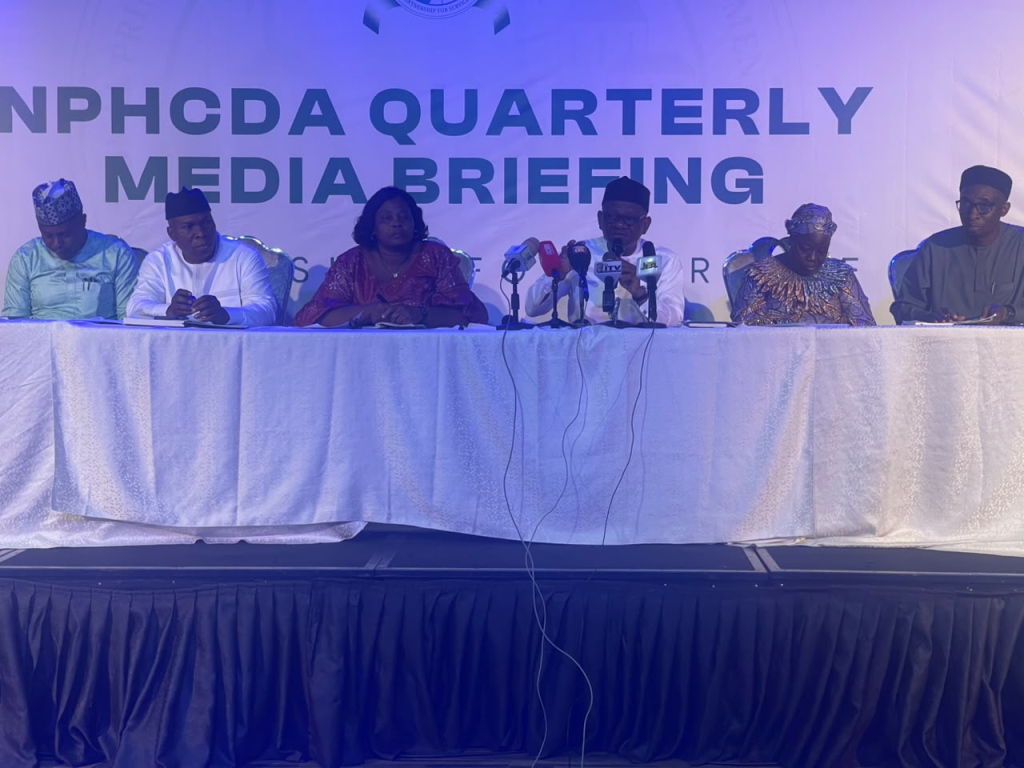
The Executive Director/Chief Executive Officer of the National Primary Health Care Development Agency (NPHCDA), Dr Muyi Aina, disclosed this at a quarterly media briefing in Abuja, where he outlined progress under President Bola Tinubu’s Health Sector Renewal Investment Initiative.
Aina said 3,526 facilities had been fully renovated, commissioned and handed over to state governments and other relevant authorities, while work was ongoing at another 908 facilities across the country.
He explained that the facilities were selected using an equity-based approach that prioritises communities with limited access to healthcare, taking into account distance, existing services and the availability of alternative healthcare providers.
According to him, the programme has significantly improved the operational capacity of primary healthcare facilities, with the number of Level Two PHCs increasing by more than 59 per cent compared with March 2024. He added that 53 per cent of the approximately 27,000 PHCs initially identified as active were now functioning at Level One or Level Two.
Aina said Level Two facilities must have reliable electricity, water and sanitation, making solar power installations and improved water systems essential components of the revitalisation programme. He also disclosed that the Federal Government had fully equipped more than 500 PHCs.
To improve public access to information, the agency has introduced a live dashboard that enables Nigerians to locate nearby PHCs and identify the services available at each facility through geolocation. The platform is accessible at phc.mphcda.gov.ng.
On healthcare utilisation, Aina said quarterly service contacts had increased from about 33 million to 34 million at the beginning of the programme to between 43 million and 45 million currently, peaking at 46 million in 2025.
He said the increase was reflected in key services, including antenatal care and immunisation, indicating growing utilisation of primary healthcare facilities.
On human resources, Aina said more than 78,000 frontline health workers had been retrained out of the 120,000 targeted under the presidential directive. He added that the agency was commencing the retraining of about 23,000 community-based health workers to extend healthcare services to remote communities.
The NPHCDA chief also highlighted progress under the Maternal and Newborn Mortality Reduction Initiative (MAMII), which was initially launched in 172 local government areas. He said the initiative had linked 773,200 pregnant women to primary healthcare centres and recorded more than 200,000 deliveries attended by skilled birth attendants between January and August 2026.
According to him, deliveries attended by skilled birth attendants increased by about 17 per cent in the first eight months of 2026 compared with the corresponding period of 2025.
Aina further disclosed that a food support programme implemented in collaboration with the First Lady had delivered 9,500 food packages to 2,488 beneficiaries across 23 local government areas.
On immunisation, he said 18.3 million girls had received the human papillomavirus (HPV) vaccine, while 102 million children had been reached with the measles-rubella vaccine. Another 882,000 children in Kebbi, Bayelsa, Ondo and Bauchi states had received malaria vaccines.
Addressing the diphtheria outbreak, Aina said 93 per cent of reported cases involved children who were either unvaccinated or partially vaccinated. He identified Sokoto, Kaduna, Katsina and Yobe among the states with high diphtheria prevalence.
Meanwhile, the Director-General of the National Health Insurance Authority (NHIA), Dr Kelechi Ohiri, said Nigeria’s health insurance coverage had increased by 42 per cent, from approximately 16 million enrollees in January 2024 to 23.02 million.
Ohiri said the growth reflected ongoing efforts to expand access to affordable healthcare, strengthen financial protection and reduce the burden of medical expenses on Nigerians.
He disclosed that at least 3.18 million poor and vulnerable Nigerians had been enrolled in health insurance through the Basic Health Care Provision Fund (BHCPF), which supports access to essential healthcare services and strengthens primary healthcare delivery.
The NHIA director-general also said free comprehensive emergency obstetric care was available in more than 270 accredited facilities, benefiting over 80,000 women. He added that the authority had funded 6,000 fistula surgeries and between 6,000 and 7,000 neonatal interventions.
According to Ohiri, the relevant authorities had approved the inclusion of prison inmates in health insurance coverage, alongside the integration of 60,000 people living with HIV and tuberculosis across five states through a Global Fund partnership.
He said the NHIA had also reviewed its tariffs for the first time in a decade, with capitation doubled and fee-for-service rates increased by 373 per cent from April 1, 2025, as part of efforts to improve service delivery and rebuild confidence in the health insurance system.
Ohiri added that 87 per cent of complaints received by the authority were resolved within 48 hours.
Both agencies disclosed that an additional ₦40 billion had been approved under the BHCPF to expand funding coverage from 8,300 to 13,512 healthcare facilities, a move expected to strengthen service delivery and improve access to essential healthcare across the country.