

















































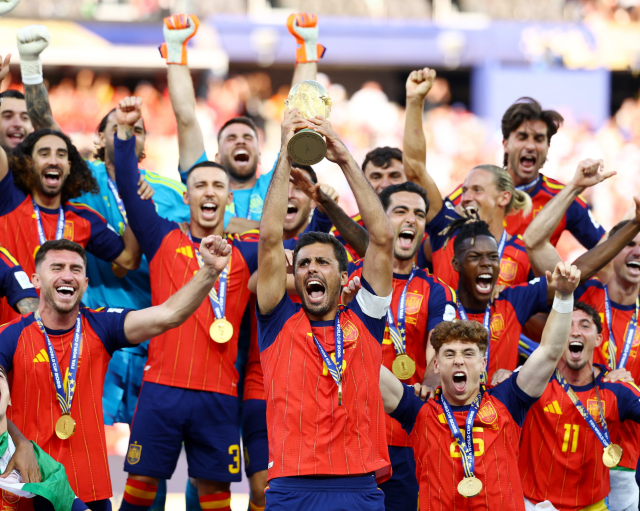
Spain defeated Argentina 1-0 after extra time to win the 2026 FIFA World Cup final at MetLife Stadium, East Rutherford, New Jersey, USA.
The tense contest remained goalless after 90 minutes before substitute Ferran Torres delivered Spain’s second World Cup title.
Argentina began with determination, creating dangerous moments, but Spain’s organised defence consistently frustrated the South Americans.
Argentina’s first setback came in the 41st minute when Lautaro Martinez received a yellow card for a foul.
Three minutes later, Nicolas Otamendi was also booked following an incident involving Martinez as the physical contest intensified.
Neither side found a breakthrough before half-time, with both teams entering the interval locked in a tense stalemate.
Argentina made an early tactical adjustment after the restart, introducing Leandro Paredes for Nicolas Gonzalez in the 46th minute.
Paredes was booked six minutes later for a reckless challenge, while Nahuel Molina replaced Gonzalo Montiel.
Spain responded in the 62nd minute by introducing Pedri and Ferran Torres for Fabian Ruiz and Mikel Oyarzabal.
Argentina made two changes eight minutes later, with Facundo Medina replacing Cristian Romero and Giovanni Simeone coming on for Rodrigo De Paul.
Spain introduced further attacking options in the 75th minute, bringing on Nico Williams and Mikel Merino.
Williams replaced Alex Baena, while Merino took the place of Dani Olmo as Spain sought greater attacking impetus.
In spite of several promising moves, neither team could break the deadlock during regulation time, forcing the final into extra time.
Argentina midfielder Enzo Fernandez received a yellow card in the 83rd minute as the increasingly physical encounter continued.
Spain made further changes in the 99th minute, introducing Martin Zubimendi for Rodri and Eric Garcia for Aymeric Laporte.
Argentina responded three minutes later, with Marcos Senesi replacing Julian Alvarez as the South Americans sought fresh energy.
Argentina coach Lionel Scaloni was booked in the 104th minute for dissent as tensions continued to rise on the touchline.
The decisive moment arrived in the 106th minute when Torres calmly converted Nico Williams’ fine assist to finally break Argentina’s resistance.
Argentina immediately pushed forward for an equaliser, but Spain’s disciplined defence stood firm and protected their slender advantage.
Alexis Mac Allister was booked in the 111th minute as Argentina’s frustration grew during the closing stages.
Spain’s defensive organisation, tactical substitutions and patience ultimately proved decisive as they secured a hard-fought victory after extra time.
The triumph secured Spain’s second FIFA World Cup title, adding another landmark achievement to their increasingly decorated international football history.
Spain’s victory also means they simultaneously hold football’s two biggest international titles, following their success at the European Championship.