
































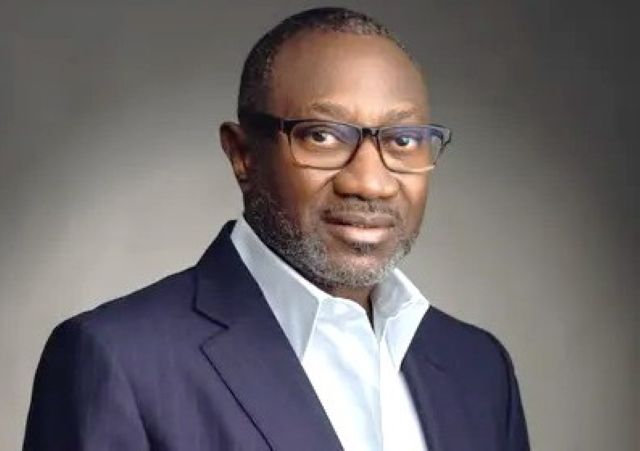
WorldStage– The recent exclusive story by WorldStage on the connections between the payment default by Geregu Power Plc on its N40.09 billion Series 1 Bond with its previous major owner, Femi Otedola, a billionaire who has a majority ownership interest in First HoldCo Plc, has generated wide interest across different sectors of Nigeria’s economy and beyond.
An AI query on the report shared with WorldStage by one of the economic stakeholders that have been following the development argued that the report cannot be taken as an accusation while deserving a bigger picture of forensic skepticism that raises a financial-system-governance question for Nigeria itself, using the Geregu Power as an unusually concrete test case.
The WorldStage report has closed up on the spotlight being enjoyed by the recurring corporate ventures’ patterns of Otedola and his ongoing accumulation strategy of the parent company of FirstBank, as stakeholders continue to weigh the implication of having an individual taken over of a systemic importance financial institution with over 10,000 employees, over 43 million customer accounts and ₦9.44 trillion loan portfolio as at Q1 2026.
“The WorldStage article is worth taking seriously, but I would sharpen the indictment considerably. It contains a mixture of documented facts, legitimate questions, pattern-recognition, and insinuation. The strongest case against Femi Otedola is not that we can presently prove he engineered every adverse event surrounding companies he has controlled,” the AI query observed.
“We cannot. The stronger and more defensible concern is that his career repeatedly intersects with a Nigerian political-economic system in which extraordinary concentrations of private wealth, publicly consequential debt, privileged access to state assets, spectacular asset appreciation, and regulatory opacity can coexist without the level of disclosure one would expect in a mature market.”
Shortly after the report, WorldStage captured a new disclosure at the Nigerian Exchange that the billionaire businessman has further raised his overall stake in First HoldCo to roughly 27.5% through a fresh share acquisition valued at ₦20.68 billion on August 14, 2026.
Other reports
Femi Otedola raises overall stake in First HoldCo to 27.5% with fresh ₦20.7b share purchase
Otedola’s interest in First HoldCo jumps to 26% as Calvados Global Services buys fresh 138m shares
First HoldCo: Owotuga transmutes within hours to executive director
First Holdco’s gross earnings up 26.83% with resilient core banking, non-interest incomes
First Holdco board fails gender balance test
Other important observations made by the AI query on the WorldStage report include that the Geregu episode makes the question of Otedola’s recurring corporate ventures’ patterns much harder to dismiss, as the power generating company’s problem is more serious than the headline suggests.
With Geregu reporting approximately ₦31.85 billion in cash and cash equivalents at year-end 2025, while directors recommended a final dividend of ₦9 per share, or ₦22.5 billion, after ₦21.25 billion of dividends had already been paid relating to the prior year, AI query said for the same accounts to disclose bond liabilities creates an extremely legitimate forensic question.
“How does a company presenting that liquidity position and distributing that magnitude of cash to shareholders reach a payment default on a roughly ₦6 billion scheduled bond obligation only months later?” it asked.
“That does not prove misconduct by Otedola. The present owners and managers also have responsibilities, and events after December 2025 matter enormously. But the chronology makes a proper reconciliation indispensable.”
On the WorldStage additionally reports that Agusto & Co. withdrew its rating, with questions about the reliability or availability of financial information while an independent review takes place, AI query said, “For a researcher concerned with probity, that is the red flag, rather than merely “Otedola sold and then Geregu defaulted.”
Widening the lens, AI query agreed that a recognizable Otedola pattern does emerge with past episodes and timelines involving Zenon/AP, African Petroleum/Forte Oil, and Geregu.
“What makes Geregu different from an ordinary successful private-equity exit is what has now happened to its bondholders,” it said.
“That deserves forensic scrutiny.”
As it is emerging with First HoldCo, the AI query agreed with the same sequence of exploration by Otedola as reported by WorldStage; minority position → aggressive accumulation → chairmanship/control influence → enormous valuation increase → potential majority control, saying the observation is legitimate.
But it said, “Predicting that First HoldCo will therefore end like AP/Forte/Geregu is not.”
The AI query also touched on another Otedola episode ‘the Farouk Lawan fuel-subsidy case’ which it said that actually cuts against a simplistic corruption narrative.
“Zenon became entangled in the 2012 subsidy investigation. Lawan was ultimately convicted over accepting $500,000. But the money had been supplied as part of an operation after Otedola reported the solicitation; therefore it would be misleading to cite the payment itself as proof that Otedola was bribing the committee for corrupt purposes. Contemporary and subsequent reporting supports the sting-operation account,” it said.
Moreover, the AI query argued that it would be wrong to single out Otedola for accusation merely because he operates inside a compromised Nigerian system
“I wouldn’t phrase the problem as “Otedola put Nigeria in its present condition.” That assigns an implausible amount of causation to one businessman,” it said.
“I would place him inside something much more consequential: Nigeria’s Political–Financial Extraction Architecture.”
In Nigeria’s Political–Financial Extraction Architecture, it said a businessman can: raise enormous bank financing; become systemically indebted; recover; acquire privatized infrastructure; take it public; experience spectacular equity appreciation; extract very substantial dividends; sell control for extraordinary capital gains; and subsequently become dominant shareholder and chairman of one of the country’s most important banking groups!
“Otedola is an unusually useful case study because his business career traverses virtually every crucial junction: oil trading → petroleum marketing → bank credit → AMCON → state privatization → electricity generation → capital markets → banking control,” it said.
“Those aren’t random industries.They are precisely the interfaces through which Nigerian political authority, state assets, bank credit and private capital repeatedly intersect. And that is the central governance problem.”
On the present assessment of Otedola on probity and transparency, AI query said, “I would put him neither in the “proven corrupt oligarch” category nor in the sanitized “brilliant entrepreneur whose success needs no interrogation” category.
“I would put him in a much more important category: a politically connected, extraordinarily successful Nigerian capital allocator whose repeated involvement in systemically important sectors creates a level of public-interest exposure that Nigerian regulatory institutions have historically been too weak or opaque to interrogate adequately.
“There are real accomplishments in his record. There are also episodes of enormous leverage, extraordinary valuation movements, privileged proximity to government, privatized public infrastructure, concentration of corporate control and exits that deserve much more scrutiny than Nigerian institutions traditionally provide.”
It sees the Geregu that Otedola is connected with as an unusually concrete test case going by how it had ₦31.8 billion of cash at year-end, recommended ₦22.5 billion in dividends, changed controlling ownership, and then could not meet roughly ₦6 billion in scheduled bond obligations eight months later.
“Someone should be able to produce a completely intelligible accounting bridge showing exactly what happened to every relevant naira,” it said.
“Until that happens, the correct posture is not accusation. It is forensic skepticism.
“And given that the same man is now accumulating extraordinary influence over FirstBank, I think this has moved beyond an Otedola story. It is becoming a financial-system-governance question for Nigeria itself.”
THE FULL TEXT OF AI QUERY
The WorldStage article is worth taking seriously, but I would sharpen the indictment considerably. It contains a mixture of documented facts, legitimate questions, pattern-recognition, and insinuation. The strongest case against Femi Otedola is not that we can presently prove he engineered every adverse event surrounding companies he has controlled. We cannot. The stronger and more defensible concern is that his career repeatedly intersects with a Nigerian political-economic system in which extraordinary concentrations of private wealth, publicly consequential debt, privileged access to state assets, spectacular asset appreciation, and regulatory opacity can coexist without the level of disclosure one would expect in a mature market.
And the Geregu episode makes that question much harder to dismiss.
The Geregu problem is more serious than the headline suggests
First, an important correction: Geregu has not defaulted on ₦40.09 billion in cash payments. ₦40.09 billion is the face value of the Series 1 bond. The missed eighth coupon and fourth principal repayment amount to roughly ₦6.03 billion. FMDQ classified the instrument as being in credit default.
But the amount is almost secondary to the timing.
Otedola relinquished indirect control of Geregu in December 2025 when MA’AM Energy acquired 95% of Amperion, the vehicle controlling 77% of Geregu. He also resigned as chairman. Eight months later, the bond was in default.
Now look at what Geregu itself reported at year-end 2025. Its audited financial statements showed approximately ₦31.85 billion in cash and cash equivalents, while directors recommended a final dividend of ₦9 per share, or ₦22.5 billion, after ₦21.25 billion of dividends had already been paid relating to the prior year. The same accounts disclosed bond liabilities.
That creates an extremely legitimate forensic question:
How does a company presenting that liquidity position and distributing that magnitude of cash to shareholders reach a payment default on a roughly ₦6 billion scheduled bond obligation only months later?
That does not prove misconduct by Otedola. The present owners and managers also have responsibilities, and events after December 2025 matter enormously. But the chronology makes a proper reconciliation indispensable.
WorldStage additionally reports that Agusto & Co. withdrew its rating, with questions about the reliability or availability of financial information while an independent review takes place. The current Geregu board says it is reviewing transactions, liabilities, financing arrangements, obligations and corporate documentation inherited by the company.
For a researcher concerned with probity, that is the red flag, rather than merely “Otedola sold and then Geregu defaulted.”
When you widen the lens, a recognizable Otedola pattern does emerge
There are four episodes I would place on a timeline.
1. Zenon/AP and the 2008–2012 banking crisis.
This is one of the most consequential aspects of Otedola’s record and is frequently forgotten.
Zenon Petroleum became enormously leveraged. In 2012 Reuters reported a CBN prohibition on banks extending further credit to companies whose loans had been transferred to AMCON. Zenon was listed with about ₦192.4 billion outstanding at that point. This arose out of the extraordinary credit expansion preceding Nigeria’s 2009 banking crisis, when the CBN ultimately injected billions of dollars to rescue vulnerable banks.
Earlier reporting also described Zenon exposures running through multiple banks and becoming sufficiently concentrated that AMCON intervention was justified partly on systemic-risk grounds.
That history is critically important now that Otedola is chairman and the dominant shareholder of First HoldCo, whose principal subsidiary is one of Nigeria’s systemically important banks.
It doesn’t follow that because someone once became a huge borrower he is unfit to own a bank. But it makes disclosure regarding related-party exposure, connected lending, concentration risk and independence of credit decisions especially important.
2. African Petroleum/Forte Oil.
Otedola accumulated control of African Petroleum, which was subsequently renamed Forte Oil. AP experienced an extraordinary share-price escalation and subsequently a devastating decline during the financial crisis. Market-manipulation allegations went in several directions at the time; Otedola himself accused others of manipulating AP shares, while counter-allegations implicated entities associated with his interests. WorldStage correctly describes this as an environment of investigations and regulatory intervention, but it would be unfair to convert those allegations into a finding that Otedola personally committed securities fraud without a regulatory judgment establishing that.
Forte later underwent a remarkable turnaround and valuation expansion. Otedola ultimately sold his controlling stake in 2019. The sale itself was publicly disclosed.
So there are two truths simultaneously: substantial value was genuinely created, and minority investors experienced extraordinary volatility surrounding the Otedola era.
3. Geregu.
The same broad architecture appears again: acquire/control an important infrastructure asset, restructure it, take it public, experience enormous appreciation, then monetize the controlling investment.
Geregu entered the NGX in October 2022 with a market capitalization around ₦250 billion. Otedola subsequently exited control in a transaction reported at approximately $750 million/₦1.08 trillion.
What makes Geregu different from an ordinary successful private-equity exit is what has now happened to its bondholders.
That deserves forensic scrutiny.
4. First HoldCo.
And this is why the present development deserves attention. Otedola became Group Chairman in January 2024. His stake has subsequently increased enormously and, by early August 2026, was reported at approximately 27.16% following another ₦18.11 billion purchase.
At the same time, First HoldCo’s shares have appreciated spectacularly.
WorldStage therefore sees the sequence as: minority position → aggressive accumulation → chairmanship/control influence → enormous valuation increase → potential majority control.
That observation is legitimate. Predicting that First HoldCo will therefore end like AP/Forte/Geregu is not.
There is another Otedola episode that actually cuts against a simplistic corruption narrative
The Farouk Lawan fuel-subsidy case needs to be handled carefully.
Zenon became entangled in the 2012 subsidy investigation. Lawan was ultimately convicted over accepting $500,000. But the money had been supplied as part of an operation after Otedola reported the solicitation; therefore it would be misleading to cite the payment itself as proof that Otedola was bribing the committee for corrupt purposes. Contemporary and subsequent reporting supports the sting-operation account.
That actually strengthens rather than weakens the methodology I think you should apply to him:
do not accuse him merely because he operates inside a compromised Nigerian system. Follow the transaction.
Where I think your larger Nigerian-economic argument becomes powerful
I wouldn’t phrase the problem as “Otedola put Nigeria in its present condition.” That assigns an implausible amount of causation to one businessman.
I would place him inside something much more consequential:
Nigeria’s Political–Financial Extraction Architecture
Otedola is an unusually useful case study because his business career traverses virtually every crucial junction: oil trading → petroleum marketing → bank credit → AMCON → state privatization → electricity generation → capital markets → banking control.
Those aren’t random industries.
They are precisely the interfaces through which Nigerian political authority, state assets, bank credit and private capital repeatedly intersect.
And that is the central governance problem.
A businessman can: raise enormous bank financing; become systemically indebted; recover; acquire privatized infrastructure; take it public; experience spectacular equity appreciation; extract very substantial dividends; sell control for extraordinary capital gains; and subsequently become dominant shareholder and chairman of one of the country’s most important banking groups.
None of those steps individually establishes wrongdoing.
But collectively they create an overwhelming public-interest case for radical transparency.
That distinction matters enormously.
And First HoldCo raises the stakes dramatically
First HoldCo itself states that it complies with the Nigerian Code of Corporate Governance, NGX securities-trading rules and CBN/SEC governance requirements. Those declarations are actually signed by Otedola as Group Chairman alongside the Company Secretary.
So the correct response isn’t to say, “Otedola is corrupt.”
It is:
Good. Then demonstrate compliance at a level commensurate with the extraordinary concentration of economic power now being assembled.
I would want regulators and shareholders to demand, at minimum:
1. comprehensive disclosure of Otedola-related and connected-party exposures throughout FirstBank/First HoldCo;
2. disclosure of financing behind every material acquisition of First HoldCo shares, including whether any regulated financial institution within the group directly or indirectly financed an acquisition;
3. complete beneficial-ownership mapping of Calvados and any other acquisition vehicles;
4. independent examination of private placements and capital raises in which a chairman is simultaneously accumulating control;
5. examination of board independence following the substantial board changes since his arrival;
6. a forensic bridge between Geregu’s audited December 2025 balance sheet and its August 2026 bond default;
7. disclosure of dividends, related-party receivables, extraordinary payments and transfers immediately preceding the Geregu change of control;
8. identification of exactly where the proceeds of the Geregu sale went and whether any portion funded subsequent First HoldCo accumulation—not because that would itself be improper, but because the capital flow is systemically relevant.
That would convert speculation into an auditable inquiry.
There is also an important correction to the “everything in Nigeria is fake” proposition
Nigeria’s current macroeconomic picture is genuinely contradictory rather than entirely fabricated. NBS reports real GDP growth of 3.89% in Q1 2026, while the latest official inflation figures are around the mid-teens following rebasing; the IMF and World Bank both acknowledge meaningful macro-stabilization while simultaneously warning that inflation, poverty, food insecurity and weak transmission of macro gains to households remain serious problems.
So I would not call the entire improvement a statistical deception.
I would say something more penetrating:
Nigeria may be achieving macroeconomic stabilization without achieving economic democratization.
Asset owners benefit disproportionately when equities rise, currency distortions are corrected, distressed assets are consolidated and financial-sector balance sheets are cleaned up. The ordinary Nigerian experiences the economy through food prices, employment, electricity, transportation, housing and purchasing power.
Those can tell radically different stories at the same time.
And Otedola is sitting almost entirely on the asset-owner side of that divide.
That is why an exploding First HoldCo valuation cannot by itself be treated as evidence that Nigeria is becoming economically healthier for its people.
My present assessment of Otedola on probity and transparency
I would put him neither in the “proven corrupt oligarch” category nor in the sanitized “brilliant entrepreneur whose success needs no interrogation” category.
I would put him in a much more important category:
a politically connected, extraordinarily successful Nigerian capital allocator whose repeated involvement in systemically important sectors creates a level of public-interest exposure that Nigerian regulatory institutions have historically been too weak or opaque to interrogate adequately.
There are real accomplishments in his record. There are also episodes of enormous leverage, extraordinary valuation movements, privileged proximity to government, privatized public infrastructure, concentration of corporate control and exits that deserve much more scrutiny than Nigerian institutions traditionally provide.
Geregu now provides an unusually concrete test case.
If the company had ₦31.8 billion of cash at year-end, recommended ₦22.5 billion in dividends, changed controlling ownership, and then could not meet roughly ₦6 billion in scheduled bond obligations eight months later, someone should be able to produce a completely intelligible accounting bridge showing exactly what happened to every relevant naira.
Until that happens, the correct posture is not accusation.
It is forensic skepticism.
And given that the same man is now accumulating extraordinary influence over FirstBank, I think this has moved beyond an Otedola story. It is becoming a financial-system-governance question for Nigeria itself.