










































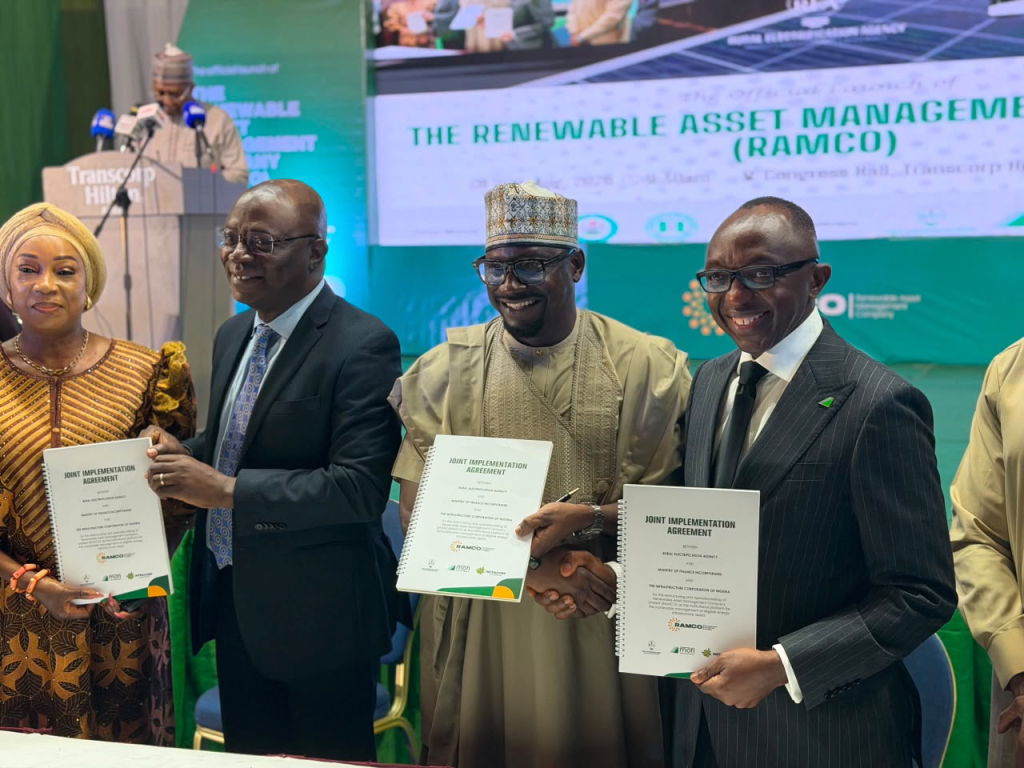
WorldStage— The Renewable Asset Management Company (RAMCO) is set to unlock fresh private capital for Nigeria’s renewable energy infrastructure while reducing the sector’s dependence on government funding and sovereign borrowing, the Rural Electrification Agency (REA) has said.
REA Managing Director and Chief Executive Officer, Abba Aliyu, disclosed this at the launch of RAMCO in Abuja, describing the initiative as a new model for ensuring the long-term sustainability and commercial viability of Nigeria’s off-grid renewable energy assets.
According to Aliyu, RAMCO will allow mature renewable energy assets to generate predictable revenues that can be aggregated, refinanced and leveraged to attract additional private investment into new infrastructure.
“RAMCO will reduce Nigeria’s dependence on government budgets, sovereign borrowing, and development finance to expand electricity access,” he said.
He explained that the company would also create a mechanism for recycling capital already deployed in mature renewable assets, thereby freeing liquidity for the development of new projects under stronger commercial and regulatory frameworks.
Aliyu said the initiative would go beyond asset management to support the development of a domestic renewable energy manufacturing industry.
He disclosed that the REA had entered into a joint development arrangement with the Ministry of Finance Incorporated (MOFI) and the Nigeria Sovereign Investment Authority backed Infrastructure Corporation of Nigeria (InfraCorp), involving German manufacturers in the production of solar modules, batteries, inverters, street-lighting equipment and solar asset recycling.
Also speaking, the Minister of Power, Chief Joseph Tegbe, said the Federal Government was targeting power generation of 6,500MW by year-end and 8,000MW by the end of 2026, as part of efforts to strengthen electricity supply nationwide.
Tegbe said renewable energy would remain an integral part of Nigeria’s energy mix, adding that the government would deploy mini-grids in areas affected by transmission deficits.
He also disclosed that a technical audit was underway on electricity infrastructure that is more than 42 years old, with obsolete facilities expected to be replaced with modern assets.
The Minister said the government would also revisit the East-West supergrid project and put 21 dormant dams to productive use as part of efforts to expand generation capacity and strengthen the national grid.
He stressed the need for discipline in managing public infrastructure, saying public investment must be matched with proper asset management to preserve its value.
Chairman of the REA, Ayodele Fayose, described RAMCO as a major development for Nigeria’s electricity sector, arguing that building new infrastructure without ensuring its maintenance and operational continuity would undermine the value of such investments.
Fayose also called for greater public ownership and protection of electricity infrastructure to prolong the lifespan of public utilities.
Meanwhile, the Managing Director of MOFI, Dr Armstrong Takang, said RAMCO could help Nigeria unlock greater value from its public assets and improve fiscal transparency as the country pursues its ambition of becoming a $1 trillion economy.
Similarly, the Managing Director of InfraCorp, Dr Lazarus Angbazo, said professionally managed renewable energy assets could unlock asset backed financing, credit enhancement and long-term institutional capital.
“Infrastructure does not create value simply because it has been commissioned; it creates value because it continues to work,” Angbazo said.
The initiative also received support from the health sector, with the Minister of State for Health and Social Welfare, Dr Iziaq Salako, stressing that reliable electricity is essential to healthcare delivery.
Salako said between 60 and 70 per cent of Nigeria’s public health facilities experience severe power outages or energy poverty, while some teaching hospitals spend up to half of their operating budgets on diesel.
He said RAMCO could provide the operational framework needed to sustain renewable energy installations in healthcare facilities and support the Federal Government’s Nigeria Power-for-Health Initiative, which targets electrification of at least 30 per cent of health facilities by the end of 2027.