





























































By Abiodun Folarin
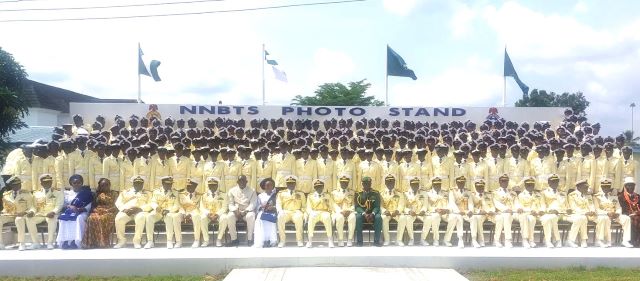
WorldStage– The Nigerian Navy has identified technology and research development as some of the major challenges confronting the service as it marks 70 years of existence.
Chief of Policy and Plans at Naval Headquarters, Rear Admiral Akinola Olatunde, disclosed this on Thursday during an international press briefing in Abuja ahead of the Nigerian Navy’s 70th anniversary celebration.
Olatunde said the Navy had evolved significantly over the decades, transforming from a coastal policing force into a strategic institution playing diplomatic, military, and regional security roles.
According to him, the Nigerian Navy has grown “from a modest coastal policing navy into a formidable instrument of national power, regional stability and blue-water prestige through resilience and strategic adaptability.”
The Nigerian Navy was established on June 1, 1956, as the Naval Defence Force with 250 officers and men, alongside 11 ships inherited from the Colonial Marine Department of the Royal Navy. It became the Royal Nigerian Navy in 1958 before adopting its current name in 1963 when Nigeria became a republic.
The modern Nigerian Navy was formally established under Act No. 21 of 1964 as a statutory branch of the Armed Forces of Nigeria, with Commodore J.E.A. Wey emerging as the first Nigerian to head the service.
Despite its achievements, Olatunde said the Navy still faces challenges linked to the evolving nature of modern security threats, especially in cyber operations, autonomous systems, and transnational crimes such as drug trafficking.
“We need to improve in the areas of cyber security and in responding to evolving crimes, including attempts to move drugs from neighbouring countries into Nigeria,” he said.
The naval chief also spoke on the issue of submarines and underwater warfare, noting that Nigeria’s current strategic assessment does not place underwater threats among its immediate priorities.
“We have drones that operate on autonomous systems, but regarding submarines, countries acquire such platforms based on long-term threat assessments. Within Africa, underwater threats are not among our top priorities for now, though we continue to monitor global developments,” he explained.
Olatunde further stressed the need for Nigeria’s armed forces to become more self-sufficient in military production, drawing lessons from the Nigerian Civil War when the country faced difficulties procuring weapons and military equipment.
“We would have loved to be further ahead in terms of technology and research development. One major lesson from the Civil War is that the armed forces must strive for independence in military production,” he said.
He added that the military was intensifying efforts toward self-reliance, particularly in shipbuilding, weapons systems, and other technology-driven areas.
“There was a time the country was denied access to procure armaments, forcing us to depend on other parts of the world. That is why the military is looking at ways to become self-sufficient, not just in ship production, but also in weapons systems and other technological areas,” he added.





