

























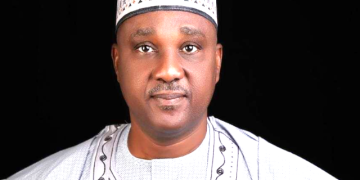






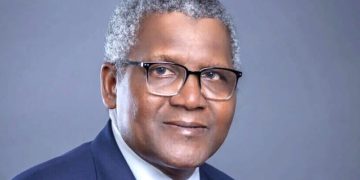

WorldStage– A Nigerian space physicist, Professor Sola Rufus Fayose has advocated for increased investment in space research to shift Nigeria from being a consumer to a global producer of space technology.
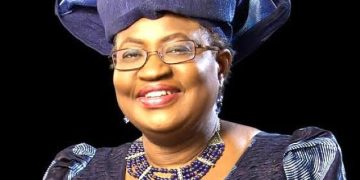
Fayose from the Department of Physics and Electronics at Adekunle Ajasin University, Akungba Akoko (AAUA) made the call in his 62nd inaugural lecture delivered at AAUA on May 12, 2026, titled “Earth and Extraterrestrial Intelligence: Nexus for Human Existence and Comfort.”
He stated that earth and extra-terrestrial intelligence underlined the strategic importance of developing local space technologies.
Fayose urged that Nigeria should not just be a consumer, but a global player in space products and services.
The call coincides with efforts to review Nigeria’s space roadmap, which includes ambitious plans for indigenous satellite construction and a goal of launching a Nigerian astronaut by 2030.
Recent initiatives, such as the proposed $200 million investment for a satellite manufacturing facility, indicate progress toward producing satellites locally and building on the work of the National Space Research and Development Agency (NASRDA).
He urged Nigeria to copy Asian countries like China and Taiwan in developing a self-sufficient space programme to enhance socio-economic development.
He identified increased funding as a key step to enable Nigerian scientists to create sustainable and locally designed technologies.
Fayose’s advocacy highlights a critical strategic pivot for Nigeria’s scientific, economic, and technological development.
According to him, developing indigenous space assets creates jobs, and reduces dependence on expensive foreign satellite data and hardware.
He stated further in the lecture: “Local manufacturing of sub-systems protects critical communication, defense, and maritime monitoring networks.
“High-resolution geospatial data optimizes crop yields. It detects pest infestations early and improves national food security.
“Precision weather forecasting tracks floods, desertification, and oil spills rapidly across the Niger River Basin.”
To transition from consuming to producing space technology, he recommended Nigeria implementing upgrade university-based laboratories like the Space Physics Research Laboratory at AAUA to handle hardware prototyping; bridge the gap between academic research papers and commercial ventures via regional technology incubation hubs; boost joint grants between the National Space Research and Development Agency (NASRDA) and local universities.
He also canvased domestication of supply chains through provision of tax incentives for engineering companies building local electronic sensors and tracking systems.
Prof. Fayose academic milestones underscore the background of the advocacy. He is an expert in space physics, focusing on Total Electron Content (TEC) and ionospheric variations using data from GPS-SCINDA systems.
He joined Adekunle Ajasin University, Akungba Akoko (AAUA) in 1997, rising to the rank of Professor of Space Physics in 2021.
He served as the Pioneer Director of the Technology Park and Incubation Centre (Tech-PIC), and Acting Director of the Centre for Space, Energy, and Environmental Research (CSEER).
He has authored four books and 29 journal articles, specializing in ionospheric scintillations, Total Electron Content (TEC), and magnetic anomaly dynamics.
His work is backed by sponsorships from the United Nations Office for Outer Space Affairs, the US Air Force Research Laboratory, and the International Centre for Theoretical Physics (ICTP).