












































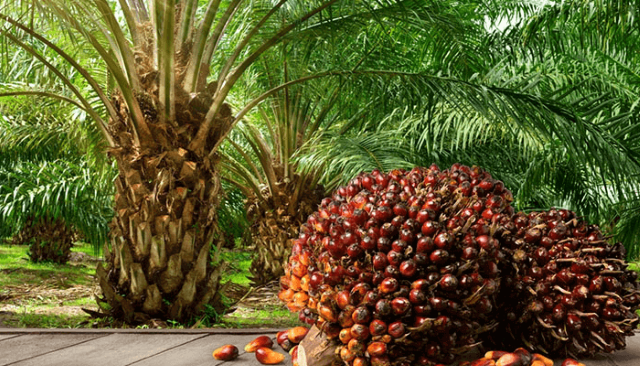
WorldStage– The Federal Government of Nigeria has partnered with investors and other stakeholders to revive the palm oil subsector and reduce the country’s dependence on imports through a programme aimed to achieve up to $500 million in annual import savings, while boosting local production and strengthening food sovereignty.
The Minister of Agriculture and Food Security, Sen. Abubakar Kyari, disclosed this on Thursday at a national stakeholders’ meeting on the joint development of Nigeria’s palm oil production capacity in Abuja.
Kyari, represented by his Senior Technical Assistant, Mr Ibrahim Alkali, said the initiative, in collaboration with Mass Industrial Development and Logistics Ltd., would operate under a Public-Private Partnership (PPP) model.
He said the success of the initiative will depend on strong collaboration among stakeholders.
“It is time to move from intention to implementation. Nigeria must take bold and deliberate steps to reposition agriculture as a driver of economic growth,” he said.
Kyari recalled that Nigeria accounted for over 40 per cent of global palm oil supply in the 1960s but now produces about 1.4 million metric tonnes annually, against a domestic demand of over 2.5 million metric tonnes.
He said the resulting deficit of more than one million metric tonnes forced the country to spend between 500 million and 600 million dollars annually on imports.
“What this means is that we are exporting opportunities and importing what we have the capacity to produce,” he said.
The minister said the initiative aligned with President Bola Tinubu’s Renewed Hope Agenda and the National Oil Palm Development Strategy.
He explained that the strategy sought to expand production, improve yields, strengthen processing capacity and integrate smallholder farmers into structured value chains.
Kyari added that state governments would play critical roles in providing access to land, enabling policies, infrastructure and community engagement.
He said the first phase of the programme would establish seven integrated oil palm estates of 10,000 hectares each across participating states.
According to him, the estates will function as complete economic ecosystems, combining production with modern milling, refining, storage and distribution facilities.
He said the second phase would focus on downstream processing and manufacturing of palm-based products to enhance value addition and competitiveness in local and export markets.
Kyari said participating states and investors would benefit from increased investment inflows, expanded economic activity, higher internally generated revenue and improved livelihoods.
He urged states, investors and development partners to key into the initiative, citing strong market potential and government backing.
Earlier, the Permanent Secretary of the ministry, Dr Marcus Ogunbiyi, described the meeting as timely and necessary for repositioning the palm oil subsector.
Ogunbiyi, represented by Mr Abba Waziri, Director of Farm Input Support Services, commended the Managing Director of Mass Industrial Development and Logistics Ltd., Mr Emmanuel Anyaralu, for initiating the programme.
In a presentation, Anyaralu said the initiative would be a game changer for the palm oil value chain and aligned with the government’s agricultural transformation agenda.He added that it would boost revenue generation and improve the livelihoods of farmers.