














































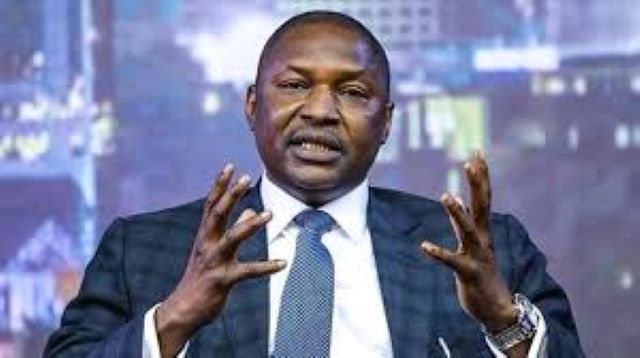
WorldStage– A fresh spotlight has returned to one of the most contentious episodes of the Buhari administration, the attempted payment of $16.9 million in legal fees to two lawyers reportedly linked to then Attorney-General of the Federation (AGF), Abubakar Malami, during the repatriation of $321 million in Abacha loots from Switzerland.
The controversial $16.9 million payment for the recovery of a $321 million Abacha loot from Switzerland was initially blocked by then-Finance Minister Kemi Adeosun, but was later approved and paid to two private Nigerian lawyers after she resigned in September 2018.
A Swiss lawyer, Enrico Monfrini, was reportedly to have been engaged by the Nigerian government in the early 2000s and had already completed the legal work for the recovery of the $321 million (plus interest) from Luxembourg and Switzerland. He had been paid in full by the previous administration. All that remained was for the Attorney-General of the Federation (AGF) to sign a Memorandum of Understanding (MoU) with the Swiss authorities for the physical repatriation of the funds.
Despite Monfrini having completed the work, the AGF and Minister of Justice, Abubakar Malami, engaged two private Nigerian lawyers, Oladipo Okpeseyi and Temitope Isaac Adebayo, in 2016 for a controversial success fee of approximately $16.9 million (later cited as 5% of the recovered sum, in line with the government’s policy of capping fees at 5% with no upfront payments). Malami argued this was a separate recovery effort and that Monfrini had made unacceptable demands, which Monfrini denied.
According to official correspondence and subsequent disclosures, the payment representing roughly five percent of the recovered funds was first initiated in 2018 when Malami wrote to then Minister of Finance, Kemi Adeosun, requesting approval for professional fees to be paid to two Nigerian lawyers, Temitope Adebayo and Emmanuel Eze. The lawyers were engaged by Malami to “monitor” the repatriation process.
However, Adeosun rejected the request on grounds that the approval was “dubious,” lacked supporting documentation, and did not establish that the lawyers had played any meaningful role in the recovery. She reportedly demanded evidence of service before any release of funds, triggering internal friction between her office and the AGF.
At the time, the Swiss lawyer who actually handled most of the two-decade-long recovery effort, Enrico Monfrini, had already been paid approximately $14 million less than what the Nigerian lawyers were poised to receive.
Civil society groups, including SERAP, quickly denounced the proposed $16.9 million payment as wasteful and suspicious, pointing to a broader pattern of secret asset-recovery practices under Malami’s watch.
The controversy coincided with the intensification of Adeosun’s NYSC certificate scandal, which ultimately led to her resignation in September 2018.
Although the Presidency denied any link between the two issues, analysts have repeatedly cited the timeline as evidence of political pressure.
Following Adeosun’s exit, her successor, Zainab Ahmed, reportedly approved and released the $16.9 million payment between 2019 and 2020, despite the outstanding questions surrounding the basis for the fees.
The episode remains one of the most widely referenced controversies of Malami’s tenure, resurfacing frequently in debates about transparency, accountability, and the management of recovered public assets in Nigeria.
The issue also highlighted a lack of transparency in the handling of recovered assets, leading to further calls for accountability.
Malami was invited and questioned by the Economic and Financial Crimes Commission (EFCC) in late November 2025 regarding the repatriation of the Abacha loot and other financial transactions.
The EFCC’s investigation focuses on several financial transactions during his tenure, including the handling of the $490 million (or $322.5 million depending on the source) Abacha loot and allegations of duplicating the recovery process by engaging private lawyers when the work was allegedly already completed by a Swiss lawyer.
Malami has dismissed the allegations as “baseless, illogical and entirely devoid of substance,” describing the probe as a “political witch-hunt”.
He insists that the recoveries were distinct tranches and all actions were transparent and in the public interest, monitored by the World Bank.
Following interrogation, Malami was released on bail, but his passport was seized, and he was instructed to report to the EFCC headquarters daily throughout December 2025 for further questioning.
He confirmed the engagement was successful and expressed confidence that the truth would vindicate him.
The investigation is ongoing, and Malami continues to cooperate with the anti-graft agency.
He has since been released but is required to report to the EFCC daily for further interrogation.





