



















































By Segun Otokiti
Until Oladepo Caleb Olugbenga, the overall best graduating student from Ladoke Akintola University of Technology (LAUTECH) with a 4.89 CGPA, publicly credited the Nigerian Education Loan Fund (NELFUND) for enabling his success, many parents had lived in denial of the reality of the educational facility.
Parents’ belief in the NELFUND loan scheme is mixed, characterized by low initial awareness, confusion over the process, and concern regarding repayment given high graduate unemployment, according to studies by British Association for International and Comparative Education.
However, many recognize it as a necessary, structured alternative to dropping out, prompting NELFUND to increase awareness campaigns.
Early reports indicated that many parents were unaware their children were applying, and some feared the loan would create inescapable debt or invite government harassment.
Yet, many see the loan as a crucial, structured, and much-needed intervention for students at risk of dropping out due to poverty, with some expressing gratitude for the initiative.
That the loan is not a grant leads to anxiety about repayment after graduation among students, and has geared NELFUND into recognizing the lack of awareness and is expanding sensitization to parents and guardians at the grassroots level to improve trust and adoption.
In spite of all the misgivings about the Fund, the story of Caleb Olugbenga Oladepo, featuring a challenging upbringing and academic triumph, has become a powerful, organic marketing tool for the ruling All Progressives Congress (APC) government, highlighting the efficacy of President Tinubu’s student loan initiative.
Oladepo’s narrative is a compelling tale of resilience. Growing up in a rural part of Osun State without electricity and coming from a background where food and clothing were daily struggles, the odds were stacked against him.
However, on January 14, 2026, he was honored as the Best Graduating Student in Electronic and Electrical Engineering.
He publicly acknowledged that the NELFUND loan, an initiative under President Bola Ahmed Tinubu, played a critical role in his journey, stating, “Your loans made it possible.”
Oladepo’s public declaration of gratitude on social media platforms, has become a key narrative for the APC in showcasing the practical benefits of its policies.
The loan scheme is presented not as a distant policy, but as a direct, tangible tool that alleviated the burden of tuition and upkeep.
As Oladepo noted, “Imagine having an itch-free education career,” which directly paints the government as a facilitator of academic excellence, rather than a cause of institutional strikes.
It provides a strong counter-narrative to opposition critiques, specifically referencing, promises by others to reverse the policy.
Oladepo’s backgrounding his success with NELFUND intervention has resonated with many Nigerians, reinforcing the image of the ruling APC government as one that cares for the underprivileged.
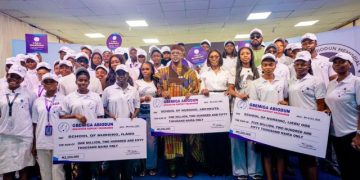
NELFUND, which has already disbursed over N489 million in loans to 2,271 LAUTECH students, is increasingly being seen as a “lifesaver,” especially among students from modest backgrounds.
By aligning the success of a top student with a government policy, the APC is successfully framing its educational reform as a transformative success story.
The narrative of Oladepo Caleb Olugbenga is more than just an academic achievement; it is a significant political asset. It highlights a student’s success made possible by the NELFUND loan, creating a, “Thank you, Mr. President,” narrative that strengthens the ruling APC’s position ahead of future political contests.
The acknowledgement sparked significant national conversation and reports of upcoming presidential recognition.
Reports emerged on April 24, 2026, indicating that Olugbenga is set to meet President Bola Tinubu at the State House following the widespread attention his story received.
Presidential media aides shared his story as evidence of the administration’s successful educational policies.
As of late April 2026, NELFUND has reportedly disbursed over ₦242.4 billion to support roughly 1.38 million students nationwide.
The scheme continues its nationwide rollout with several critical updates. Recent disbursements include ₦1.4 billion to LAUTECH and ₦676.6 million to Ekiti State University for the 2025/2026 session.
The portal for the 2025/2026 academic session remains a primary focus, with periodic extensions granted to institutions that require more time for student registration.
What is clear in Caleb’s story is that it has moved beyond personal achievement and now sits within a larger national conversation about education financing, social mobility, and the effectiveness of emerging support structures for students in public universities.
By ensuring that financial constraints do not prevent students from completing their education, NELFUND is earning more public acceptance as agent of promotion of economic mobility and building a knowledge-driven economy by Olugbenga’s story.