





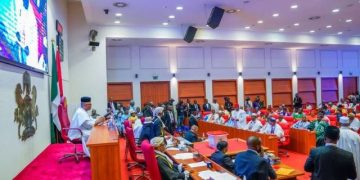






















































WorldStage– The Independent National Electoral Commission (INEC) chairman, Prof. Joash Amupitan has stated that delivering free, fair, and credible elections in 2027 can only be possible if the Commission is granted full financial autonomy.
The critical warning was issued by the leadership of Nigeria’s electoral umpire during the public presentation of the book “Shadows: Protest Essays on Africa’s Most Consequential Country (1999–2023)” in Abuja.
The commission cautioned that its persistent dependence on ordinary government budget approvals compromises its operational efficiency and threatens to weaken public trust in the upcoming general elections.
Although the Nigerian Constitution places INEC on a first-line charge, the current mechanism is structurally weak, according to the Commission, adding that the federal government still retains ultimate control over when and how funds are released from the Consolidated Revenue Fund (CRF).
To fix the vulnerability, the commission is advocating for constitutional reforms that would link its core funding directly to the Federation Account.
This structural shift, according to it, would ensure a seamless, non-politicized flow of resources.
Conducting localized polls—such as governorship and state assembly elections—frequently costs significantly more than presidential and national assembly exercises.
It started that relying on basic federal budgetary allocations to meet these varying state-level logistical demands is increasingly unsustainable.
Beyond national polls, the leadership clarified that INEC’s fiscal strain stems from its massive, continuous nationwide obligations, adding that in the 2027 general elections, the commission is constitutionally tasked with registering and monitoring all national political parties; continuously updating the national register of voters; and providing clean voter registries to State Independent Electoral Commissions (SIECs) to facilitate local government polls.
Aside funding, call for stronger institutions while securing stable financial backing is the primary operational priority, with the commission noting that money alone cannot solve Nigeria’s electoral challenges.
It emphasized that democratic progress ahead of 2027 requires deep behavioral and institutional changes across the political spectrum.
“A massive volume of post-election litigation is triggered long before the first ballot is cast due to flawed, opaque party primaries and candidate imposition,” the Commission noted.
INEC has requested amended powers under the Electoral Act to strictly police political parties, forcing them to adhere to their own internal constitutions and legal.
“Delivering a continental standard election in 2027 requires matching institutional funding with equal professionalism from security agencies, the media, civil society groups, and voters themselves,” the Commission pointed out.





