











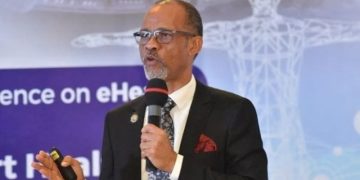





















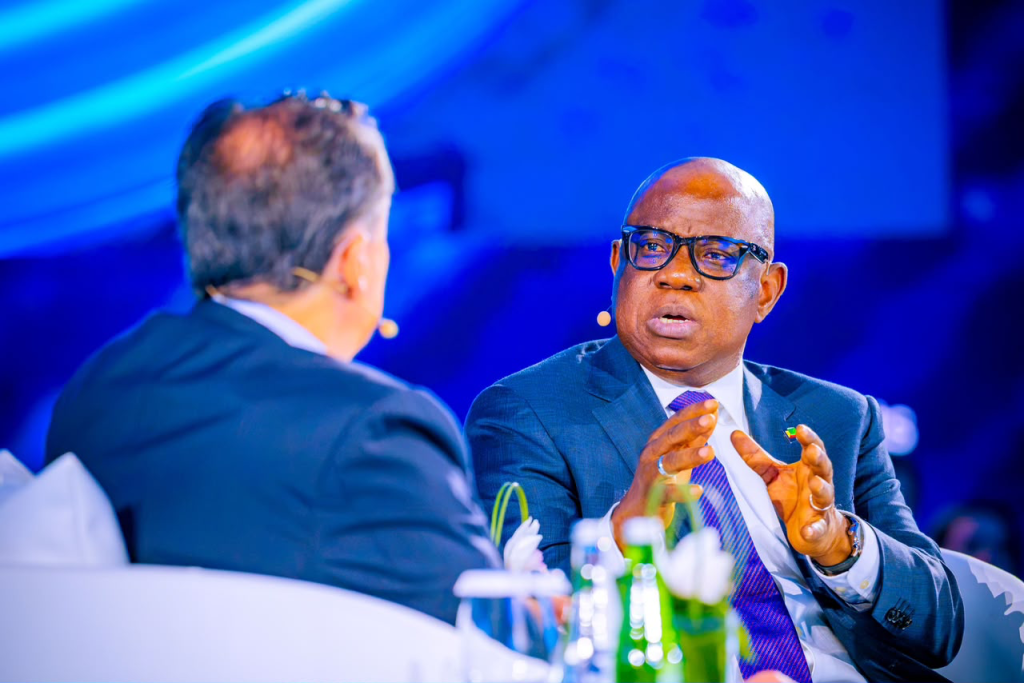
GCEO NNPC Limited, Engr. Bashir Bayo Ojulari, speaks to John Defterios, Chairman, MENA, APCO, during an Energy Talk Session titled “Nigeria’s Reform Agenda: Competing for Energy Capital”, at the ongoing 2026 Abu Dhabi International Petroleum Exhibition and Conference (ADIPEC), in Abu Dhabi, UAE, on Tuesday.
By Abiodun Folarin
WorldStage— Nigeria’s crude oil production has increased by 600,000 barrels per day (bpd), rising from about 1.2 million bpd to 1.8 million bpd, following ongoing reforms and improved collaboration between the Nigerian National Petroleum Company Limited (NNPC) and its industry partners.
Group Chief Executive Officer of NNPC Limited, Bashir Bayo Ojulari, disclosed this on Tuesday at the 2026 Abu Dhabi International Petroleum Exhibition and Conference (ADIPEC) in the United Arab Emirates, saying the development had strengthened Nigeria’s position in the competition for international energy investments.
Ojulari, who spoke during an Energy Talk titled, “Nigeria’s Reform Agenda: Competing for Energy Capital”, said the production growth was driven by the implementation of the Petroleum Industry Act (PIA) 2021, an improved investment climate, better investment decisions and closer collaboration with industry partners.
He said NNPC was targeting crude oil production of two million barrels per day by 2027, adding that the company was focusing on maintaining existing infrastructure, protecting base production, increasing output from producing assets and accelerating new projects.
“The figure of 1.8 million barrels per day is a stage in a journey towards our objective. We are concentrating on the basics, which are maintaining our infrastructure, protecting base operations and executing the projects that will take production higher,” he stated.
On investment prospects, the NNPC boss disclosed that commercial agreements covering approximately $20 billion in investments had been concluded, citing major developments such as TotalEnergies’ Ubeta project, Shell’s Bonga South-West and Eni’s Zabazaba.
He said the company was also developing new partnerships with international investors, including the Abu Dhabi National Oil Company (ADNOC) and Chinese investors in Nigeria’s refining sector, while engaging global oilfield service companies to expand domestic service capacity.
On domestic gas development, Ojulari said NNPC was targeting national gas production of 10 billion standard cubic feet per day (Bcf/d) by 2027 and 12 Bcf/d by 2030, supported by the development of domestic consumption and export markets.
He disclosed that the Obiafu-Obrikom-Oben (OB3) gas pipeline was completed in August 2026, while the Ajaokuta-Kaduna-Kano (AKK) pipeline was expected to deliver gas to Abuja before the end of the year to support power generation, data centres and industrial hubs.
Ojulari also highlighted the government’s compressed natural gas (CNG) programme following the removal of petrol subsidy, noting that more than 400 CNG conversion centres had been established, while over 1,000 trucks transporting petroleum products had switched to CNG.
On regional energy integration, he said countries involved in the Nigeria-Morocco Gas Pipeline project had aligned and executed the necessary agreements, while Nigeria, Algeria and Niger had also reached alignment on the development of the Trans-Saharan Gas Pipeline.
The NNPC chief executive said the company’s Board and management were committed to delivering on the mandate given to it by President Bola Tinubu, adding that a baseline assessment of its assets and infrastructure had provided management with a clearer understanding of its operational strengths and areas requiring improvement.
“Our track record will be judged by what is done and not by what is said,” he stated.
He reaffirmed NNPC’s commitment to transparency and execution excellence, citing the company’s conduct of two consecutive earnings calls as part of efforts to strengthen accountability and investor confidence.
The 2026 ADIPEC, held under the patronage of UAE President, Sheikh Mohamed bin Zayed Al Nahyan, and hosted by ADNOC, brought together more than 239,000 participants from over 170 countries, including ministers, chief executives, investors and technology leaders, to discuss energy security, investment and global supply challenges.




