


















































WorldStage– As Nigeria approaches 2026, few policy shifts have sparked as much online debate as the Central Bank of Nigeria’s revised cash withdrawal framework.
Viral explainers, including a widely shared post by a self-styled financial literacy advocate known as “IKING,” have framed the new rules as a tightening squeeze on citizens’ access to their own money. Yet beyond the sensitive language lies a more complex reality, one that reflects Nigeria’s ongoing struggle to balance monetary control, financial inclusion, digital modernization, and public trust in institutions, against the backdrop of global anti-money laundering norms and a largely informal domestic economy.
The CBN “cash withdrawal reset policy” in 2026 refers to a significant revision of cash handling rules designed to promote a cashless economy, curb money laundering, and reduce cash management costs.
The policy, effective from January 1, 2026, primarily increases weekly withdrawal limits from previous restrictions while eliminating fees on cash deposits.
The policy introduces specific limits on cash withdrawals across all channels (over-the-counter, ATM, and PoS), but these are now higher than the previous 2022-2025 limits. It also affects the cumulative weekly cash withdrawal limit for individuals set at ₦500,000, a fivefold increase from the prior ₦100,000 limit. Same for corporate weekly limit, with the policy providing for corporate entities withdrawing up to ₦5 million per week, a tenfold increase from the previous ₦500,000 limit.
Also, daily ATM withdrawals are now capped at ₦100,000 per customer, within the overall weekly limit. All currency denominations may now be loaded in ATMs.
With regard to third-party cheques, the over-the-counter encashment limit for third-party cheques remains at ₦100,000, and this amount counts toward the weekly limit.
In addition, the policy removes special authorisation, thereby discontinuing previous provision that allowed individuals and corporates to obtain special one-time monthly approval for larger withdrawals (₦5 million for individuals and ₦10 million for corporates). Withdrawals above the specified weekly limits are not prohibited but will attract processing fees. Individually, a 3% fee is charged on the amount exceeding the ₦500,000 weekly limit while a 5% fee is charged on the amount exceeding the ₦5 million weekly limit.The revenue from these excess withdrawal fees is split, with 60% going to the operating bank and 40% to the CBN.
Other major changes include: No cash deposit limits; all cumulative deposit limits and associated fees on excess deposits have been completely removed to encourage more money in the formal banking system; and revenue-generating government accounts (federal, state, and local) and accounts of microfinance and primary mortgage banks exempt from the withdrawal limits. However, previous exemptions for embassies, diplomatic missions, and aid-donor agencies no longer apply.
Various stakeholders widely discussed the policy, including individuals and bodies. Among them are Dr. Rita Sike from the CBN, members of the House of Representatives, and financial experts like Taoheed Oyekanmi.
Central Bank of Nigeria (CBN)
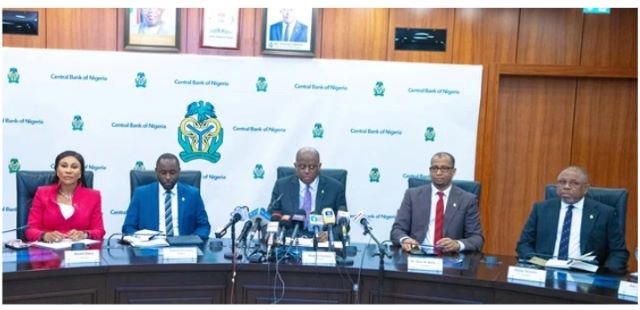
Dr. Rita I. Sike, Director of the Financial Policy & Regulation Department, who official announced the policy in a circular, stated that the changes were made to streamline previous regulations, reflect current economic realities, moderate cash management costs, and curb money laundering risks.
However, members of the Nigerian House of Representatives have been prominent critics and commentators on the policy, particularly the initial, more restrictive version in 2022. Hon. Magaji Dau Aliyu moved a motion of urgent public importance, leading to the House resolution that the CBN suspend the policy pending a probe. Hon. Ndudi Elumelu, the Minority Leader, was one of the few lawmakers who supported the CBN policy, arguing it would help curb banditry and corruption.
Many other unnamed lawmakers vehemently condemned the decision, arguing it would limit financial inclusion and negatively affect small businesses and the rural economy.
Financial experts and analysts as well as commentators have offered analyses of the policy’s impact. While Taoheed Oyekanmi (Servant Leader, Kwara Info and Other National Updates) provided commentary and shared information regarding the policy’s potential effects on the market and small businesses, Samu Kami (Lead Research and Insights at Norin Bger) discussed the potential “mismatch” between the policy and other initiatives, noting the “gray area” regarding corruption and the pivot towards a technology-driven cashless economy.
Other experts and analysts also broke down the policy for the public, explaining the new limits and what they mean for everyday Nigerians and businesses.
To understand the 2026 policy, context matters, says Adebamiwa Olugbenga Michael, a Lagos-based political analyst who explores ethnic economics and urban policy. According to him, between 2022 and 2025, Nigeria operated one of the strictest cash-withdrawal regimes in its history, introduced alongside the controversial naira redesign. “Weekly over-the-counter limits were set as low as ₦100,000 for individuals and ₦500,000 for corporates, with daily ATM caps of ₦20,000. While waivers allowed higher withdrawals up to ₦5 million for individuals and ₦10 million for companies, these required documentation and discretionary approvals,” he opines.
Commenting further he says: “The new framework, effective January 1, 2026, replaces that discretionary system with clearer, automated rules, ₦500,000 weekly for individuals and ₦5 million for corporates across all channels, with penalties rather than permissions for excesses. In policy terms, this is less a clampdown than a structural reset.
“Factually, many viral posts are correct on the numbers excess withdrawals attract charges of 3% for individuals and 5% for corporates, applied only to the amount above the weekly cap. ATM and POS daily limits now rise to ₦100,000, a fivefold increase from previous levels.
“What is often missed, is that baseline access to cash has actually expanded for routine users, while cash deposits are now entirely unrestricted and fee-free. This distinction matters. The policy discourages large, secretive cash movements but makes ordinary access smoother, especially compared to the cash scarcity that paralysed commerce during the 2023 crisis.
“Where posts like IKING’s fall short is in framing. By portraying the policy as an existential threat “your money is in the bank, but your hands cannot reach it” they tap into lingering trauma from past cash shortages. Such rhetoric carries weight in a country where institutional trust remains fragile, but it risks overstating the constraint.
“For most Nigerians, whose weekly withdrawals fall well below ₦500,000, the practical impact is minimal. The policy functions less as a prohibition and more as a pricing signal, cash is still available, but heavy reliance now comes at a cost.
“That said, the concerns raised are not frivolous. Nigeria’s informal sector accounts for over half of GDP and employs the vast majority of workers, many of whom operate in cash by necessity rather than choice. Market traders, rural communities with weak connectivity, and small landlords may face adjustment costs. There are also legitimate privacy and surveillance concerns as reporting thresholds tighten.”
Globally, however, Nigeria is not an outlier. From India to Sweden, governments are redirecting economies toward traceability to curb illicit flows, improve tax compliance, and reduce the high cost of printing and securing physical cash. The challenge lies in sequencing, ensuring digital infrastructure, consumer protection, and financial literacy keep pace with regulation.
For individuals and businesses, the adaptation playbook is clear, rely more on transfers and USSD, separate personal and business accounts, keep records, and reserve cash for truly cash-dependent needs. For policymakers, the task is harder but more urgent, expand rural connectivity, support POS agents transparently, and communicate policy changes without ambiguity or shock.”
The 2026 cash withdrawal policy is neither a silver bullet nor a quiet enforcement tool. It is a test of Nigeria’s ability to reform pragmatically, learning from past missteps, while guiding citizens through change with clarity rather than fear. In that balance lies the credibility of economic governance in the years ahead.