














































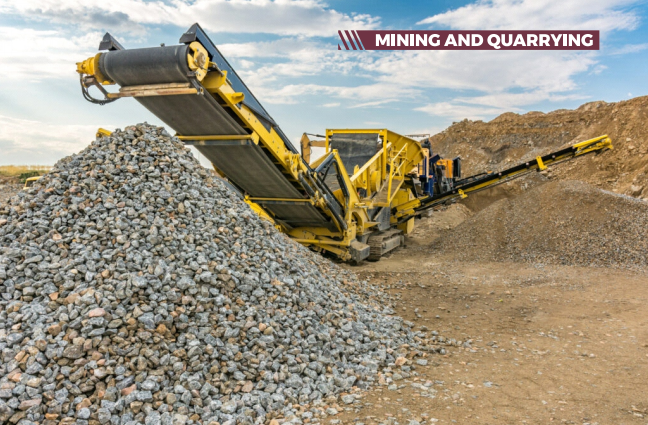
WorldStage Nigeria’s Macroeconomic Outlook 2026– Demand and Trade Dynamics: Nigeria’s mining and quarrying sector is experiencing a mix of challenges and opportunities. The sector has significant potential, with the country boasting over 40 valuable mineral deposits, including gold, iron ore, lead, and zinc.
With Nigeria’s solid minerals exports reaching ₦100.81 billion in Q3 2025, reflecting stronger non-oil export momentum, and with global demand for critical and energy transition minerals such as lithium, cobalt, and rare earth elements projected continue grow in 2026, as industries worldwide scale up electric vehicles, batteries, and renewable technologies.
The demand and trade dynamics for the sector in Nigeria will be driven by increasing domestic demand for minerals in 2026. Other drivers are infrastructure development and construction projects. Other minerals that Nigeria is blessed commanding global demand are gold, coal, tin, limestone, iron ore, lead-zinc and those for renewable energy storage.
Investment and Funding
Nigeria is getting prepared for the global expectation as a significant supplier of critical minerals for the energy transition. The country committed $630 million to expand exploration activities in 2025 while the Nigerian Mineral Exchange (NME) has been busy enhancing mineral trading and export logistics.
The investments in the solid minerals in 2025 were mostly on lithium. Over $1.3 billion were committed by a consortium comprising Canmax, Jiuling, Avatar New Energy, and Ganfeng. Another lithium deal was about $850 million committed to processing plants in Nasarawa State. A $400 million rare-earth and critical minerals processing facility backed by the federal government is also in the mix.
While the federal government shelled out ₦1 trillion for geological exploration, data generation, and sector de-risking to crowd in private capital, more of that are expected in 2026.
Other funding windows include the Kaduna State Government’s $150 million Green Mining Investment Fund to support exploration and development of critical minerals. Solid Minerals Development Fund (SMDF) has shared flexible financing options. They will come with technical support for mining projects, focusing on precious metals and critical minerals.
African Finance Corporation (AFC) and SMDF have partnered to deploy project development funding and technical advisory to fast-track commercial-scale mining projects in Nigeria. The Bank of Industry (BOI) offers single-digit interest loans with flexible collateral requirements for small-scale miners while government has introduced tax incentives, including a three-year tax holiday and import duty waivers, to attract investments in the mining sector.
Government Reforms
Nigerian Minerals & Mining Bill approved in April 2023 aims to introduce incentives for foreign investors while strengthening local content requirements.
The Ministry of Mines and Steel Development has been restructured into two separate entities: the Ministry of Solid Minerals Development and the Ministry of Steel Development.
The Nigeria Mineral Value Chain Regulations implemented in July 2021, mandates local processing of raw minerals like gold and lithium.
Similarly, the Mineral Resources Decision Support System launched in May 2024 provides global investors with easy access to geological and policy data.
The government is enforcing local content requirements, including the use of local engineers and procurement of goods from Nigerian companies.
The federal government wielded the big stick in 2025 with the revocation of over 1,200 dormant licences. Reforms also compelled formalisation of artisanal miners, coupled with the deployment of mining marshals to improve compliance and reduce illegal operations.
Mining sector got a chunk of the N4.23 trillion allocated for about 50 capital projects across key sectors in the 2026 budget to complement the Ministry of Solid Minerals Development’s reforms to promote private sector participation. The private sector is also being wooed with digital platforms like One-Gov Cloud and 1Gov Cadastre. They are conceived to streamline licensing, improve transparency, and accelerate approvals for investors.
Challenges
Notwithstanding the zeal for technology to upscale solid minerals sector, gradual adoption is still expected in 2026, particularly for safety monitoring and resource mapping.
The sector has its own share of inadequate infrastructure, such as roads and power supply. Security issues in certain regions make mining sites a no go area. Regulations too come with their hurdles and complex frameworks. Regulatory overlap and bureaucracy could create uncertainty for investors. Sometimes they impede investment and development. The illegal mining activities too pose environmental degradation danger and loss of revenue.
Meanwhile, despite the big ticket investments, limited access to finance and funding constraints still hinder exploration and development aspirations of some investors.
Opportunities
Like the saying that the more you look, the less you see, Nigerian government has issued approximately 7,000 mining licenses so far, but fewer than 1,000 mines are operational. This utilization gap could be gold mine for those that can weather the storm.
The ideas of partnerships with countries like France and Australia to enhance technical capabilities and exploration have be floated through government initiatives, like the Nigerian Mineral Resources Decision Support System. The general consensus is that the sector has potential for job creation and economic diversification. That growing demand for critical minerals like lithium and gold cannot be ignored.
*Extract from WorldStage Nigeria’s Macroeconomic Outlook 2026.