









































By Abiodun Folarin
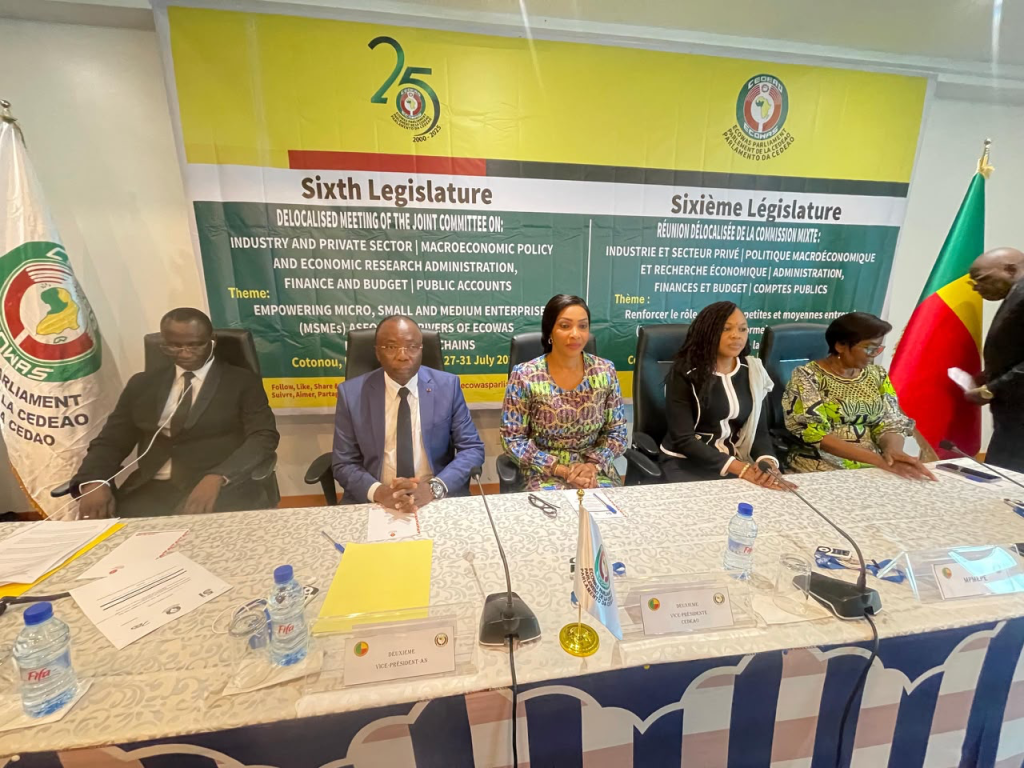
WorldStage- The Parliament of the Economic Community of West African States (ECOWAS) has called for urgent policy reforms to strengthen Micro, Small and Medium Enterprises (MSMEs), describing the sector as a critical driver of economic growth, employment and regional integration across West Africa.
The call was made on Monday at the opening of a meeting of the Parliament’s Joint Committee on Industry and Private Sector, Macroeconomic Policy and Economic Research, Administration, Finance and Budget, and Public Accounts in Cotonou, Republic of Benin.
Speaking on behalf of the committees, the Co-Chairperson, Hon. Alhagie Darbo, said despite their significant contribution to the region’s economy, many MSMEs continue to operate within the informal sector, limiting their access to finance, technology, markets, business support services and legal protection.
He noted that MSMEs remain the backbone of West African economies by creating jobs, driving innovation, promoting entrepreneurship, empowering women and young people, and facilitating cross-border trade.
According to him, the informal sector accounts for nearly 90 per cent of economic activities and employs at least 60 per cent of the labour force across ECOWAS member states.
“While this reflects the entrepreneurial resilience of our people, it also underscores the urgent need for policies that encourage formalisation, improve productivity and integrate MSMEs into regional and continental value chains,” Darbo said.
He urged ECOWAS lawmakers and stakeholders to develop practical policy recommendations capable of removing obstacles confronting small businesses and unlocking their full economic potential.
“Formalising and strengthening MSMEs is not only an economic necessity but also a pathway to sustainable development and poverty reduction,” he said.
Darbo added that the implementation of the ECOWAS Vision 2050 agenda would require stronger institutions and a more enabling business environment that allows MSMEs to compete effectively within the region and globally.
He further challenged participants to move beyond identifying existing problems and focus on practical solutions, including harmonised policies, improved access to finance, digital transformation, enhanced intra-regional trade, stronger productive capacity and greater participation of MSMEs in regional value chains under the ECOWAS Trade Liberalisation Scheme and the African Continental Free Trade Area (AfCFTA).
“I am confident that the expertise of parliamentarians, policymakers, private sector representatives and development partners gathered here will produce actionable recommendations capable of advancing the economic transformation of our Community,” he added.
Declaring the meeting open, Speaker of the ECOWAS Parliament, Hon. Hadja Memounatou Ibrahima, said MSMEs remain central to the socio-economic development of the sub-region.
Represented by the Second Deputy Speaker, Hon. Adjaratou Traore Coulibaly, the Speaker said strengthening MSMEs could also contribute to addressing the security challenges confronting many ECOWAS countries by creating economic opportunities for women and young people.
She noted that empowering citizens through entrepreneurship and small business development would help reduce unemployment and social vulnerability, which are among the underlying factors fueling insecurity in the region.
Participants at the meeting expressed optimism that the recommendations expected to emerge from the deliberations would support policy reforms aimed at strengthening MSMEs, boosting regional competitiveness and accelerating sustainable economic development across West Africa.