























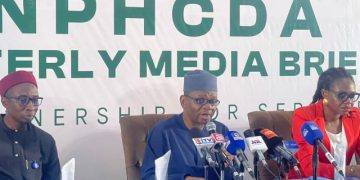




























The Permanent Secretary, Lagos State Primary Health Care Board (LSPHCB), Dr Ibrahim Mustafa has said that about five per cent of the state’s health budget directly or indirectly supports immunisation efforts.
Mustafa made the assertion on Sunday in an interview with the News Agency of Nigeria (NAN) in celebration of World Immunisation Week.
He noted that routine immunisation in the state was funded through a mix of federal vaccine supply and state-level investment in logistics, cold chain systems and service delivery.
These interventions, he said, were being supported by the National Primary Health Care Development Agency, as well as international partners including the World Health Organisation, UNICEF, Gavi, the Vaccine Alliance and AFENET.
“The state now commits a lot of resources to ensure that these vaccines get to the arms of the children.
“The Lagos State Government is one of the governments in the federation that is committing a lot to assist vaccination efforts.”
Furthermore, Mustafa said the state had achieved a routine immunisation coverage rate of about 66 per cent.
He, however, warned that population movement, vaccine hesitancy and a large number of “zero-dose” children continued to undermine efforts to fully protect communities from preventable diseases.
According to him, the gaps persist largely because of the city’s rapid population growth, fuelled by migration from across the country.
“Many families arriving in Lagos, the country’s commercial hub, do so with children who have not completed or even started their vaccination schedules.
“That contributes significantly to the gaps we are seeing.”
A zero-dose child is an infant who has not received any routine vaccines, specifically missing the first dose of the diphtheria, tetanus, and pertussis-containing vaccine (DTP1).
Nigeria has the world’s highest burden of zero-dose children, with 2.1 million in 2023, primarily concentrated in the Northwest and Northeast regions, specifically Sokoto, Bauchi, Zamfara, Kano, and Kebbi.
Although rural areas have higher overall numbers, Lagos State, specifically Alimosho Local Government Area, recorded over 35,000 zero-dose children, the highest for any single LGA in the country.
Mustafa estimated that Lagos was home to between 120,000 and 130,000 “zero-dose” children, the majority of whom were concentrated in informal and hard-to-reach communities such as Makoko, parts of Alimosho, and Ikorodu.
Highlighting concern over zero-dose children, Mustafa warned that the presence of large numbers of unvaccinated children threatened herd immunity, increasing the risk of outbreaks of diseases that had previously been brought under control.
“If you have many zero-dose children, herd immunity drops, and that can lead to the resurgence of vaccine-preventable diseases,” he said.
Regardless of the challenge, he stressed that Lagos remained one of the better-performing states in Nigeria, noting that its relatively strong health system continues to attracted migrants seeking better services—ironically adding pressure to the system.
To address the gaps, he said the state had intensified outreach programmes, outbreak response activities and targeted immunisation campaigns aimed at underserved communities.
The permanent secretary added that health workers had also been deployed to identify and vaccinate missed children.
Besides, Mustafa said the state had also made significant progress in expanding newer vaccines, particularly the Human Papillomavirus (HPV) vaccine, which protected against cervical cancer.
Introduced about two years ago for girls aged nine to 14, the programme initially faced strong resistance driven by misinformation and distrust.
“At one point, vaccinators faced hostility, including physical attacks in parts of Ibeju-Lekki, prompting us to deploy security escorts.”
To counter the hesitancy, he said, an extensive public engagement campaign involving religious and community leaders, media outreach and social media advocacy was inaugurated by the government.
Mustafa said groups such as the Christian Association of Nigeria and Muslim leaders in Lagos played a key role in building trust, while public figures including Aproko Doctor and Kate Henshaw helped amplify pro-vaccination messaging.
The strategy, he disclosed, paid off, as no fewer than 1.5 million girls had now received the HPV vaccine, with acceptance rising sharply after initial resistance.
“We moved from very serious hesitancy to strong demand. Now, in many cases, people are asking for the vaccine themselves,” he said.
He emphasised that strong government backing had been critical to sustaining immunisation efforts in the state.
“The recent introduction of the measles-rubella vaccine into routine schedules, for example, received strong support from Gov. Babajide Sanwo-Olu, his wife, and other top government officials, with funding provided outside initial budget provisions.”
He emphasised that such commitment was essential as Lagos continued to grapple with a growing population and persistent immunisation gaps.
“Closing these gaps requires continuous investment and collaboration.
“We are not relenting. Our goal is to ensure that every child in Lagos, regardless of where they live, has access to life-saving vaccines.”
Mustafa emphasised that sustaining routine immunisation while targeting zero-dose populations was key to preventing future outbreaks and maintaining the state’s progress in child health.
NAN reports that World Immunisation Week, celebrated from April 24 to 30, aims to promote the life-saving power of immunisation to protect people of all ages against vaccine-preventable diseases.
This year’s theme is, “For every generation, vaccines work.”
According to WHO, vaccines have long been one of the most powerful tools in public health.
WHO said over the last 50 years, vaccines have saved more than 150 million lives, because ordinary people decided to protect themselves, their children and one another.