


















































WorldStage– The Nigeria’s company that manages and operates the nation’s communication programmes, NIGCOMSAT, has disclosed its commitment to extending satellite-enabled connectivity to all local government areas across Nigeria, ensuring that the benefits of space technology reach every community, supporting economic activity, healthcare delivery, education, and social services in areas that terrestrial infrastructure has yet to serve.
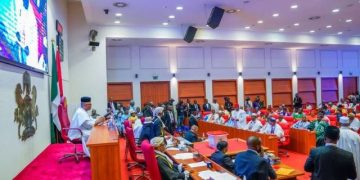
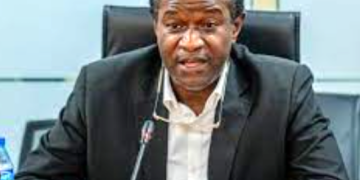
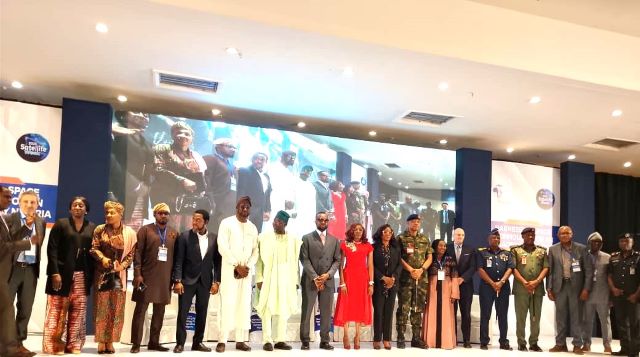
The disclosure was made by the Managing Director of the company, Mrs. Jane Nkechi Egerton-Idehen at the opening of the 2026 Nigerian Satellite Week in Abuja on Monday, March 30, 2026, an event, which also marks the 20th anniversary of NigComSat and brought together stakeholders from government, industry, and academia to discuss Nigeria’s future in the global space economy
Elaborating on the significance of the event, the NIGCOMSAT boss said the company’s effort is the clearest institutional expression of its conviction that the purpose of Nigeria’s space programme is not prestige but for the Nigerian people.
While acknowledging President Bola Ahmed Tinubu’s support, whose approval of two additional Satellites for NIGCOMSAT she said represented a defining moment for Nigeria’s space programme and a clear demonstration of the Federal Government’s commitment to sovereign satellite Capability as a driver of national development and economic competitiveness, she also referenced the invaluable guidance of the Honourable Minister of Communications, Innovation and Digital Economy, Dr Bosun Tijani, whose collaborative leadership has been instrumental in ensuring that NIGCOMSAT’s work remains aligned with the nation’s broader agenda for innovation and digital transformation.
‘As we work to Optimise the remaining service life of nigcomsat-1R and prepare The groundwork for the satellites that will succeed it, we do so with the confidence that comes from knowing our direction and the strength that comes from knowing we do not walk it alone,” Egerton-Idehen stated.
According to the M.D, the agency’s revenues grew from $650 million in 2023 to over $2 billion at the close of 2025, describing the growth as a strong return on Nigeria’s long-term investment in space technology, adding that the agency has evolved from a single-satellite operator into a multi-service provider, now delivering connectivity, broadcasting infrastructure, and broadband services to government, enterprise, and telecommunications clients across Africa and beyond.
She also confirmed that plans are underway for the launch of two new satellites, NIGCOMSAT-2A and NIGCOMSAT-2B, scheduled for 2028 and 2029. “For 2A and 2B, we have started the process. We have closed the tender and are now back into the financing and implementation stage. 2A is built to come up in 2028, and 2B for 2029,” she said.
Egerton-Idehen added that when they are up and running, they are expected to provide security within the borders and neighbouring countries and support the security agencies with real-time data collection and intelligence.
Themed “Harnessing Space for an Extraordinary Nigeria,” she said this year’s event captures precisely the moment the country found herself in. “It is a theme that challenges us not merely to celebrate what has been achieved, but to account for it honestly and to define clearly what must come next,” she staed.
She said with the convergence of technology, government and opportunities,” the gathering would examine how Nigeria accelerates its participation in a global space economy that is moving faster than at any point in its history.
According to her, the Nigerian Satellite Week carries particular Institutional significance, coinciding with the twentieth anniversary Of NIGCOMSAT Limited. “Two decades ago, Nigeria made a sovereign decision to own its place in space. That decision was not merely a technological milestone; it was a declaration of Nigeria’s readiness to participate in and shape one of the most consequential industries of the modern era. In the years since, NIGCOMSAT has grown from a single-satellite operator into a multi- service provider delivering connectivity, broadcasting Infrastructure, and broadband services to government, enterprise, and telecom clients across Nigeria and the wider African continent,” Egerton-Idehen declared.
In line with the company’s mandate to build capacity and empower the next generation of innovators, she disclosed that NIGCOMSAT has successfully conducted VSAT training programmes in Adamawa, Jigawa, Cross River, and Enugu States, equipping young Nigerians with the technical skills to harness satellite technology to deliver solutions in connectivity, education, agriculture, and commerce.
The impact of these programmes, according to her, is already visible, as startups are emerging with fresh ideas that strengthen Nigeria’s digital economy and expand the reach of the nation’s space ecosystem.
“Complementing this capacity-building work is the NIGCOMSAT Accelerator Programme, a dedicated initiative to incubate and support early-stage technology ventures working at the intersection of satellite applications, last-mile connectivity, precision agriculture, and digital logistics.
“Across two cohorts, the programme has built the human and institutional capital that Nigeria’s space economy will require over the next decade. Tomorrow, we formally launch Cohort 3.0, a milestone that signals, with clarity, that the Accelerator is not a pilot. It is a permanent and expanding feature of how Nigeria builds its next generation of space-economy companies,” she said.
Building Nigeria’s space future through strategic alliance, Egerton-Idehen confessed, is not an abstract aspiration but the work NIGCOMSAT has been doing, consistently and at pace.
She also disclosed that in the past two years, revenue has doubled and that landmark Low Earth Orbit connectivity partnership has been secured with Eutelsat, one of the most significant commercial agreements in NIGCOMSAT’s history.
“Strategic cooperation with The Kenya Space Agency has been initiated, deepening Nigeria’s bilateral engagement in Africa’s emerging space economy, and NIGCOMSAT now holds the Vice Chairmanship of the Global Satellite Operators Association, placing Nigeria at the table where International satellite policy, spectrum governance, and orbital Resource frameworks are actively shaped.
“These achievements are the compounding return on Nigeria’s original sovereign decision, and they are the institutional credibility that NIGCOMSAT brings to every conversation, including the ones in this room today,” she stated.
The NIGCOMSAT boss assured that the work of building Nigeria’s space future is well underway and being done by the institutions, innovators, investors, and policymakers gathered at the event.