





















































By Abiodun Folarin
WorldStage– The Central Bank of Nigeria has retained the country’s benchmark interest rate at 26.5 per cent, signalling continued caution over inflationary pressures and uncertainties in the global economy despite signs of relative macroeconomic stability.
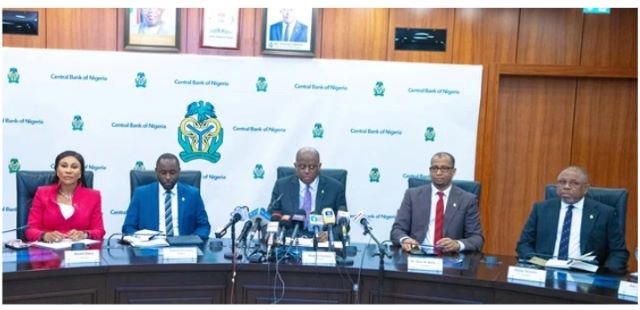
Governor of the apex bank, Olayemi Cardoso, announced the decision on Wednesday at the end of the 305th meeting of the Monetary Policy Committee (MPC) held in Abuja.
Cardoso said all 11 members of the committee voted to retain the Monetary Policy Rate (MPR) at 26.5 per cent after reviewing recent developments in both the domestic and global economies, as well as assessing risks to Nigeria’s medium-term economic outlook.
The committee also retained the asymmetric corridor around the MPR at +500 and -100 basis points, while leaving the Cash Reserve Ratio (CRR) for Deposit Money Banks unchanged at 45 per cent and Merchant Banks at 16 per cent. Non-Treasury Single Account public sector deposits were also retained at 75 per cent.
The MPC’s latest decision comes amid renewed inflation concerns following a marginal rise in headline inflation for two consecutive months.
Data released by the National Bureau of Statistics showed that Nigeria’s headline inflation rate rose to 15.38 per cent in March 2026 from 15.06 per cent recorded in February.
Despite the uptick, Cardoso said members of the committee viewed the current inflationary trend as temporary and largely driven by external developments rather than domestic structural weaknesses.
According to him, the committee remains optimistic that existing monetary and fiscal reforms would support a gradual return to disinflation in the coming months.
“The MPC recognises its transitory nature and remains confident that the current macroeconomic environment is sufficiently robust to support a return to disinflation,” Cardoso stated.
He explained that the committee paid close attention to the impact of the ongoing Middle East crisis, which has continued to trigger increases in global energy prices, transportation costs and supply chain logistics.
However, the CBN governor noted that the Nigerian economy had so far absorbed much of the external shocks due to policy reforms already implemented by the monetary authorities.
He said the MPC considered it necessary to sustain the current monetary tightening stance in order to preserve gains already achieved in stabilising the foreign exchange market, moderating inflation expectations and restoring investor confidence.
Analysts say the decision to retain rates reflects the apex bank’s balancing act between curbing inflation and supporting economic growth amid persistent exchange rate volatility and fragile global economic conditions.
The committee reiterated its commitment to closely monitor both domestic and international economic trends and take appropriate measures aimed at ensuring price stability and sustainable economic growth.