










































By Segun Otokiti, Abuja
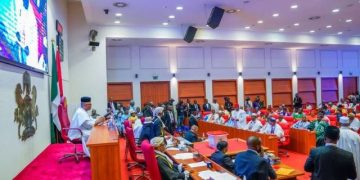
WorldStage Newsonline– Nigeria’s Senators on Wednesday unanimously agreed to harsh penalties, not excluding capital punishment, for vandals of electric power infrastructure across the country.
The agreement arose from the debate on an amendment that sought to criminalize the persistent vandalism of power infrastructure in the country and clarify ongoing transitional arrangements between the Nigerian Electricity Regulatory Commission (NERC) and subnational regulators.
The debate, aimed at decisively rescuing Nigeria’s collapsing power sector, also examined the general principles of the Electricity Act (Amendment) Bill, 2025, sponsored by Senator Enyinnaya Abaribe (Abia South).
Widely regarded as a potential turning point in the nation’s electricity reform efforts, the Bill proposes far-reaching amendments to the Electricity Act, 2023, aiming to resolve operational, legal, and financial bottlenecks that have plagued the Nigerian Electricity Supply Industry (NESI).
Leading the debate, Senator Abaribe warned that the power sector is teetering on the edge of total collapse, beset by trillions in debt and severe regulatory confusion.
He said the amendment was a necessary response to the disturbing findings of the Senate Committee on Power, which recently undertook a detailed diagnostic review of the industry.
Abaribe said, “The Nigerian power sector is hanging on a cliff and requires immediate and drastic action to rescue it from total collapse.
He noted that the Bill touches on 28 clauses aimed at restoring efficiency, legality, and public confidence in the sector.
Among the critical elements of the Bill are provisions to strengthen coordination between federal and state governments in the aftermath of the constitutional amendment that moved electricity regulation to the concurrent legislative list.
The amendment also seeks to criminalize the persistent vandalism of power infrastructure, and clarify ongoing transitional arrangements between the Nigerian Electricity Regulatory Commission (NERC) and subnational regulators.
It also establishes frameworks for host community engagement, and provide a legal foundation for a targeted subsidy model through the Power Consumer Assistance Fund.
Abaribe emphasized that the Bill would not place any new financial burden on the Federal Government.
Instead, he said, it would remove ambiguities in the existing law, tighten oversight, and provide legal tools to address sabotage and poor sectoral governance.
The Bill drew widespread support from senators, many of whom described it as bold, timely, and potentially revolutionary.
Senator Muhammad Tahir Monguno (Borno North) likened the amendment to the Petroleum Industry Act in its transformative potential.
He noted that vandalism had kept parts of his constituency in darkness for over six months. He praised the bill’s provision for stronger punishment to deter such acts.
Senator Lola Ashiru (Kwara South), Vice Chairman of the Senate Committee on Power, endorsed the amendment as a necessary next step in Nigeria’s electricity reform journey.
He highlighted the urgency of addressing mounting sectoral debt owed to generation, transmission, and distribution companies.
Senator Muhammad Adamu Aliero called for even harsher penalties and potentially capital punishment for vandals.
He noted that the federal government continues to shoulder substantial costs even after privatization.
Senator Solomon Olamilekan Adeola, Chairman of the Senate Committee on Appropriations, added that budgetary allocations to MBET (Nigerian Bulk Electricity Trading Plc) are insufficient to meet its obligations, leading to inefficiencies and, in some cases, sabotage by contractors themselves.
Senator Garba Maidoki criticized distribution companies (DISCOs) for ignoring Senate resolutions and overburdening consumers with rising electricity tariffs, while failing to pay gas suppliers like the NNPC for years.
“Even as a Senator, I struggle to pay my electricity bills,” he admitted, calling for a total restructuring of the rate system.
Senator Buhari Abdulfatai and Senator Sahabi Yaú similarly called for strict punitive measures against repeat vandals and criticized the unjust practice of DISCOs claiming ownership of transformers bought by communities with public funds.



