







































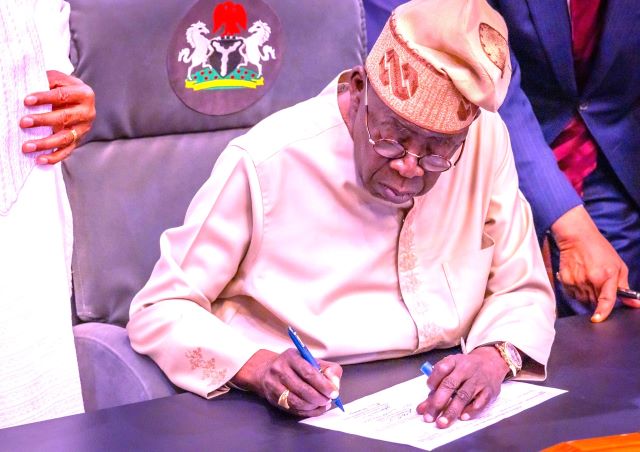
WorldStage— The administration of Nigeria’s President Bola Tinubu has initiated steps to secure three new World Bank financing facilities totaling $1.5 billion.
Bank documentation indicates that the proposed funding is split evenly, with $500 million allocated to each of three key developmental focus areas: climate resilience, social protection, and early childhood development.
According to the institutional project disclosures, the $1.5 billion package is structured to reinforce vulnerable domestic sectors through targeted interventions.
A major portion serves as additional funding for environmental and landscape management, notably scaling up initiatives like the Agro-Climatic Resilience in Semi-Arid Landscapes (ACReSAL) project.
Another part of the borrowing is a dedicated resources aimed at expanding safety nets for low-income and economically distressed households, while the third part is dedicated financing structured to improve foundational health, nutrition, and learning outcomes for young children across participating states.
The Federal Republic of Nigeria is listed as the primary borrower across the project files, while execution and oversight for the individual sub-projects fall under respective federal bodies, including the Federal Ministry of Environment.
World Bank internal schedules point toward upcoming board reviews for final consideration and formal approval of the respective credit and loan tranches.
The bank’s board of executive directors has scheduled October 29, 2026, as the estimated consideration date to officially review and approve the climate facility.
The latest move underscores the federal government’s continued reliance on multilateral development financing to support structural adjustments and long-term human capital investments.
The Tinubu administration has aggressively utilized international credit lines to back its fiscal consolidation policies, following major structural shifts such as petrol subsidy removals and foreign exchange unification.
While the presidency emphasizes that these concessional loans provide relatively cheap capital necessary to buffer vulnerable households and build long-term infrastructure, the continuous accumulation of multilateral debt continues to spark intense national debate regarding foreign exchange exposure and the long-term sustainability of Nigeria’s escalating external debt service obligations.
Critics and fiscal analysts, however, continue to monitor the rapid accumulation of external debt obligations, urging strict transparency and measurable project outcomes as these multi-million-dollar pipelines move toward final board ratification.