













































By Abiodun Folarin
WorldStage– Governor of the Central Bank of Nigeria (CBN) Olayemi Cardoso, has said the remaining banks yet to meet their capital threshold to join the 33 recapitalised banks were encountering legal, regulatory, and judicial challenges that had slowed their recapitalisation process.
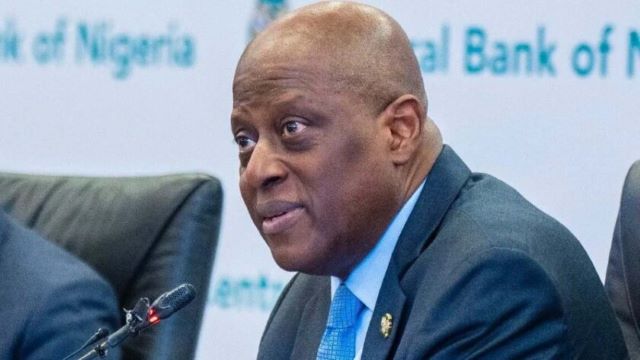
Cardoso disclosed this on Wednesday at the end of the Monetary Policy Committee’s 305th meeting in Abuja, noting that the apex bank was closely monitoring the affected institutions while ensuring stability across the financial system.
According to him, the successful recapitalisation of 33 banks has restored investor confidence, strengthened the resilience of the banking sector and ended speculations surrounding possible bank failures.
He added that the exercise, recently commended by the International Monetary Fund, reflected growing confidence in Nigeria’s economy, with domestic investors contributing about 74 per cent of the capital raised, while foreign investors accounted for 26 per cent.
Cardoso described the recapitalisation process as “relatively seamless,” stressing that the remaining banks would be allowed time to resolve their regulatory and legal constraints.
He said: “The banks you talk about are banks that have been subjected to various forms of legal, regulatory and judicial issues, and they are ones that, in the fullness of time, will be in a position to move forward on that recapitalisation trajectory.
“Bear in mind also that at the particular point in time when the Central Bank had to intervene, some of the time they would have had similar to what the other banks had was taken away from them. So, it would be unfair to compare them in terms of timing to what the other banks have been able to do within that limited time.
“However, we are fully on top of all of the banks that are still on that road of travel. There is business continuing as usual, and we support all the efforts they are making towards overcoming the regulatory and legal impediments in their own time.”
On lending trends, the CBN governor said banks were increasingly shifting attention toward small and medium-scale enterprises (SMEs), with new credit facilities rising significantly in April 2026.
According to him, the volume of new credit facilities increased to about N199 million in April from N153 million recorded in March, particularly driven by retail lending activities.
He noted, however, that lending remained heavily concentrated in general commerce and short-term facilities, which accounted for about 94.73 per cent of new credit facilities, while general commerce represented about 2.46 per cent.
Cardoso said the trend suggested that banks were gradually becoming more willing to diversify their credit exposure, especially toward SMEs and other productive sectors of the economy.
To support SME financing, he said the apex bank recently signed a Memorandum of Understanding with the Nigerian Communications Commission( NCC), to tackle fraud-related bottlenecks and improve digital connectivity for small businesses.
He also highlighted the introduction of the Global Standing Instruction (GSI), describing it as a recovery framework that enables creditor institutions to recover debts from defaulting borrowers across accounts linked to the banking system.
Cardoso further said the CBN had increased the single obligor limits for Development Finance Institutions (DFIs) to enable them extend larger credit facilities to SMEs.
He added that the apex bank was also engaging foreign DFIs to deepen support for small businesses and improve financing opportunities across critical sectors.
“This is all work in progress; we are not there yet. But all I can say is that the willingness to ensure that small credit is directed at the SME sector is certainly increasing,” he said.