





































… As Experts seek shift to Stronger Businesses, Productive Sectors for job creation, economic expansion
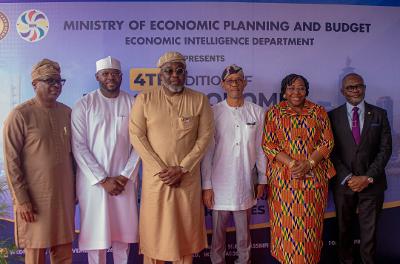
L-R Special Adviser to the Chairman, Lagos Internal Revenue Service (LIRS), Mr Tokunbo Akande; Director of Strategy, Cavista Holdings Limited, Mr Kabir Shagaya; Commissioner for Economic Planning and Budget, Mr Ope George; his counterpart for Health, Prof. Akin Abayomi; Permanent Secretary, Ministry of Economic Planning and Budget, Mrs Olayinka Ojo and General Manager, Office of the Managing Director’s Office, Bank of Industry, BOI representing his Principal, Mr Isa Omagu, during the 4th Lagos Economic Outlook 2027 Discourse themed “Development Pathways, Emerging Risks and Strategic Policy Priorities,” held at CBD-Alausa, Ikeja, on Wednesday, November 4, 2026.
The need to strengthen productive sectors, expand businesses and create sustainable employment has emerged as a major priority in discussions on Lagos State’s economic outlook for 2027, with government and private sector experts calling for stronger collaboration to unlock the State’s economic potential.
At the fourth edition of the Lagos Economic Roundtable, stakeholders highlighted the importance of moving beyond economic growth figures to policies and investments that directly improve productivity, expand business opportunities and enhance residents’ living standards.
The Commissioner for Economic Planning and Budget, Mr Ope George in his keynote address at the event, held on Wednesday in Alausa-Ikeja, outlined seven strategic priority areas to guide the State’s economic planning and policy direction in 2027.
The priorities include fiscal sustainability and revenue mobilisation; infrastructure development and economic competitiveness; employment generation and human capital development; economic diversification and private sector development; food security and resilient food systems; climate resilience and the green economy; and data and evidence-based governance.
Speaking on the theme, “Development Pathways, Emerging Risks and Strategic Policy Priorities,” George said Lagos must ensure that economic growth translates into employment opportunities, stronger businesses, improved household welfare and better living standards.
“Our focus goes beyond economic projections to shaping policies that will strengthen competitiveness, promote inclusive growth and secure a sustainable future for Lagos State,” he said.
He acknowledged that the global economy continued to face uncertainties arising from geopolitical tensions, trade disruptions, technological changes, climate challenges and evolving financial conditions, stressing the need for proactive planning and responsive policies.
According to him, the Lagos State Development Plan 2052 provides the long-term framework for building a globally competitive, sustainable and inclusive megacity.
On fiscal sustainability, George stressed the need to strengthen revenue generation, improve expenditure efficiency and ensure responsible management of public resources through improved tax administration, digitalisation, credible budgeting and effective project monitoring.
He also identified transportation, energy, water, housing, digital connectivity and logistics as essential infrastructure investments for improving productivity and economic competitiveness.
On employment, the Commissioner maintained that economic growth must create decent jobs, particularly for young people and women, through vocational training, industry-relevant skills, entrepreneurship support and improved employability.
He further highlighted the importance of supporting manufacturing, agriculture, technology, creative industries, tourism and trade, while improving access to finance and creating a business-friendly environment for Micro, Small and Medium Enterprises (MSMEs).
On food security, George called for stronger partnerships with producers and neighbouring states, improved storage and processing facilities, and efficient food supply chains to enhance food availability and affordability.
He also underscored the importance of climate resilience, renewable energy, recycling, waste recovery and credible data in strengthening the State’s development planning and public service delivery.
Speaking on the sub-theme, “Enterprise, Investment and Competitiveness: Unlocking Private-Sector Growth, Innovation and Job Creation,” the Director of Strategy at Cavista Holdings, Mr Kabir Shagaya, called on the State Government to create stronger conditions for businesses to expand, attract investment and generate employment.
Shagaya argued that Lagos needed to move beyond establishing businesses to creating enterprises capable of growing into formal employers.
His presentation, titled “Built in Lagos, Proven Globally,” identified unreliable electricity supply, high cost of capital, limited access to large-scale buyers, gaps in job-ready skills and uncertainty surrounding policy continuity as five major obstacles confronting businesses.
He illustrated how these constraints affect the ability of enterprises, particularly MSMEs, to expand, compete and create jobs.
To address the challenges facing businesses, Shagaya proposed five areas of intervention for Lagos in 2027: positioning government as an anchor buyer for local businesses; providing reliable power and digital infrastructure using public capital to attract private investment; connecting skills development programmes to actual employment opportunities and ensuring policy continuity for approved incentives and concessions.
He particularly advocated an umbrella marketplace through which Lagos-based businesses could access government and international contracts.
Cavista boss argued that Lagos had already demonstrated its capacity to establish businesses but must now focus on helping them achieve sustainable growth.
“Lagos has proven it can start businesses. 2027 must prove it can scale them,” he said.
He added that the measure of economic success should be the number of sustainable jobs created rather than GDP growth alone.
Also speaking during a panel session, Prof. Olusegun Vincent of Lagos Business School, Pan-Atlantic University, called for a reassessment of the structure of Lagos’ economy, warning that its heavy reliance on trade and services could limit the sustainability and employment impact of economic growth.
Vincent, observed that although the sectors remained major contributors to the State’s GDP, their fragmented nature and high level of informality made it difficult for residents to fully benefit from the growth they generated.
“When you look at the major drivers of the state’s GDP, they are coming from the service area and trade. Of course, you cannot equally feel the impact of this growth because it’s fragmented,” he said.
He argued that Lagos needed to pay greater attention to sectors capable of expanding production, improving productivity and creating sustainable employment, particularly manufacturing and industry.
According to him, the State must examine the policies and support mechanisms required to motivate these sectors to expand, while addressing persistent challenges such as high transportation costs and unreliable energy supply.
In the informal sector, LBS Don recommended a more targeted approach that recognises the different categories of businesses operating outside the formal economy.
He proposed distinguishing between survival-driven informal businesses and what he described as “strategic informality” — relatively large enterprises that deliberately remain informal to avoid taxation and other statutory obligations.
Explaining the distinction, he said some businesses operating in major commercial centres, including Alaba and other large markets, employ between 50 and 60 people or more but remain outside the formal system.
“They are everywhere, in Alaba, in big markets, they are employing over 50, 60. But you never know, because they try to escape, they try to under-report because of statutory obligation,” he said.
He argued that identifying and supporting such businesses to formalise would expand the State’s productive base, improve employment generation and strengthen economic growth.
According to Vincent, the government must first understand the different segments of the informal economy before designing appropriate interventions to bring viable businesses into the formal system.
He said such businesses could contribute more significantly to the State’s production capacity and employment opportunities if provided with the right support and incentives.
The discussions at the Roundtable highlighted the need to connect government policies, private sector investments and academic recommendations towards building a more productive and inclusive Lagos economy.




