










































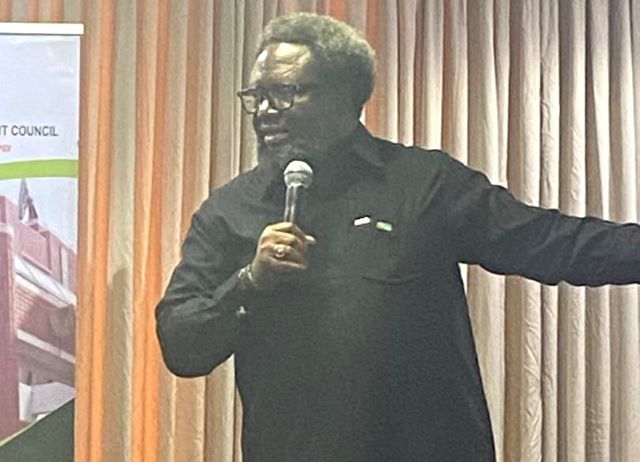
WorldStage– The Director-General of the Raw Materials Research and Development Council (RMRDC) Prof. Nnanyelugo Ike-Muonso has raised hope of Nigeria’s economic transformation with “A Bill for an Act to Amend the Raw Materials Research and Development Council Act, No. 28, 2022″ that requires a minimum of 30% local value addition to raw materials before export.
Prof. Ike‑Muonso, the Guest Speaker at The Bullion Lecture 2026 in Lagos on Thursday said the Bill which has successfully passed its third reading in the House of Representatives is awaiting presidential assent.
Once signed into law, he said it will discourage the export of unprocessed raw materials and encourage the establishment of processing industries across the country.
According to Prof. Ike-Muonso, the bill will reduce Nigeria’s dependence on imported inputs, improve the competitiveness of local products, and strengthen the foundation for industrial diversification.
Prof. Ike‑Muonso, in his presentation “From Resources to Prosperity: Catalyzing Nigeria’s Industrial Renaissance through Raw Materials Development, Value Addition, and Innovation”, he listed the Bill for 30% Value-Addition Mandate among policy catalysts that will position Nigeria to benefit from AfCFTA market of about 1.3 billion people which should also go with energy and infrastructure reforms while he mentioned the launch a Digital systems (NASISRP) designed to provide comprehensive data on raw materials in Nigeria, aiming to boost industrial development and attract investments.
He said industrialization logic should be for the nation’s raw materials to be processed to manufactured products for for export with each stage multiplying values and creating jobs. But in Nigeria situation, he said the country currently concentrated at extraction stage.
Specifically, the said the core problems are weak backward and forward linkages, commodity export dependence, low domestic value capture, and limited integration into global value chains.
For instance, he said while Nigeria’s limestone for cement, construction materials has already attained 70 to 90 percent domestic value addition, lithium being used for batteries has less than 5percent , cashew nuts has 5 to 15 percent while gold has less than 10percent among others.
He therefore listed four strategic recommendations for the nation’s prosperity to include enforcement of relevant laws- move from legislative assent to technical enforcement with standards; Infrastructure- prioritize “Utilities-First” corridors like the Lagos–Kano rail and AKK gas pipeline; Market Positioning- harness AfCFTA’s 1.3 billion-person market for value-added goods; and Incentives- reward “Capability Performance” and R&D rather than just export volume.
In conclusion he said the industrialization of Nigeria is imperative, not optional and there is the need to move from extraction to value creation while align policy, finance, and standards to build resilient, competitive economy.