


















































By Abiodun Folarin
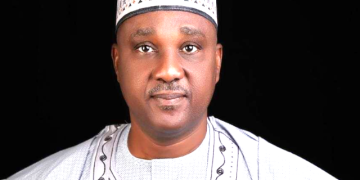
WorldStage– Nigeria’s Minister of Power, Chief Joseph Tegbe, on Wednesday commissioned a 505-kilowatt peak (kWp) interconnected solar mini-grid in Eredo Community, Epe Local Government Area of Lagos State, describing the project as a practical demonstration of the Federal Government’s commitment to expanding electricity access across the country.
Speaking at the commissioning ceremony, Tegbe said the project would provide cleaner, more reliable and affordable electricity to households, schools, healthcare facilities and businesses in the community, while supporting economic growth and improving livelihoods.
The minister praised the Rural Electrification Agency (REA) and its Managing Director/Chief Executive Officer, Dr. Abba Aliyu, for transforming the agency into a key driver of rural energy access.
“REA has evolved from a body with an admirable mandate but modest delivery into an institution that is genuinely, visibly and measurably changing lives across Nigeria,” he said.
Tegbe disclosed that more than 1,000 mini-grid projects are currently under development nationwide, while solar home systems deployed under the World Bank-supported Distributed Access through Renewable Energy Scale-Up (DARES) programme have already reached nearly 3.9 million Nigerians.
According to him, recent renewable energy project inaugurations in Kogi, Sokoto and Katsina states demonstrate that Nigeria’s energy transition is progressing steadily across communities.
“The energy transition is not an abstract policy document. It is happening community by community, kilowatt by kilowatt, life by life,” he stated.
The minister also acknowledged the support of the European Union, the Government of Germany and the Nigerian Energy Support Programme (NESP), implemented through GIZ, for funding the project under the Interconnected Mini-Grid Acceleration Scheme (IMAS).
He noted that the initiative aligns with the provisions of the Electricity Act 2023 and Nigeria’s Energy Transition Plan, which seeks to achieve net-zero carbon emissions by 2060, pledging continued collaboration with states, development partners and private investors to replicate similar projects nationwide.
In his remarks, REA Managing Director and Chief Executive Officer, Dr. Abba Aliyu, described the commissioning of the Epe Interconnected Mini-Grid as a significant milestone in Nigeria’s efforts to deliver reliable, productive and sustainable electricity.
He said the project represents more than a power intervention, stressing that it would stimulate economic activities, industrial productivity, enterprise growth and sustainable development in the community.
“This is not simply a power project. It is economic opportunity, industrial productivity, enterprise growth and a sustainable future for the people of Epe,” Aliyu said.
He described the mini-grid as evidence of what can be achieved through visionary leadership, strong partnerships, innovative financing and active community participation.
The REA chief commended the Minister of Power for providing strategic leadership and creating an enabling environment for private sector participation and renewable energy investments.
According to him, implementation of the Electricity Act 2023, promotion of decentralised energy solutions and ongoing reforms in the power sector have accelerated the delivery of innovative projects across the country.
Aliyu also praised the European Union and the German Government for their support, noting that their investments extend beyond infrastructure to livelihoods, entrepreneurship, climate resilience, economic inclusion and sustainable development.
He said projects implemented under IMAS have already provided reliable and affordable electricity to thousands of households, businesses, schools, healthcare centres and productive-use enterprises.
“Epe now joins a growing network of success stories,” he said, adding that the new infrastructure would improve electricity reliability, reduce dependence on self-generation and support critical institutions and businesses in the area.
The REA boss further revealed that the agency is pursuing an additional 5 megawatts (MW) of renewable energy capacity for Epe and surrounding communities to support industrial activities, agro-processing, cold-chain infrastructure, digital enterprises and educational institutions.
He emphasized that achieving universal energy access requires strong collaboration among government, development partners and the private sector.
“The government alone cannot deliver universal energy access. Development partners alone cannot achieve scale. The private sector alone cannot overcome every market barrier. Collaboration remains the real engine of Nigeria’s energy transition,” he said.
Aliyu urged residents to protect the facility and maximize its productive use to enhance economic prosperity and community development.