







































WorldStage– Despite holding the title as the world’s largest cassava producer, Nigeria’s local processing industry is facing a severe economic crisis.
Currently, Nigeria imports over 95% of its industrial starch and roughly 88% of its starch flour, forcing domestic processing plants to operate at a dismal 15% of their installed capacity.
Speaking on the challenge, Mr. Paul Obafemi, Head of Supply Chains at Morison Industries Plc, said cheap imports are the biggest factor hurting cassava farmers, with oversupply and low industrial demand as direct consequences.
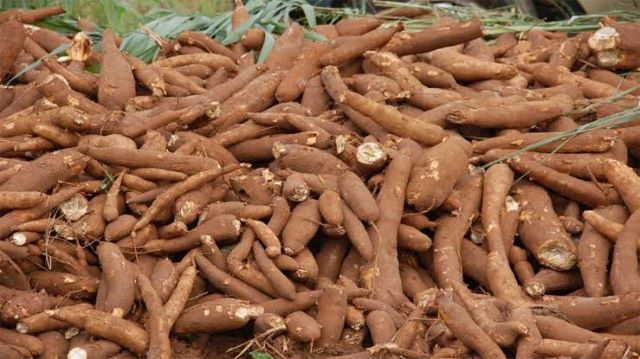
He said a pickup van of cassava sold for about ₦200,000 in 2025 when imported derivatives were still competitively priced.
“The situation worsened after the federal government granted temporary duty-free and tariff waivers on essential food imports, including some cassava derivatives.
“As industries shifted to cheaper imports, demand for local cassava fell. Processors stopped buying from farmers, and we now have oversupply.”
A renowned economist and Chief Executive Officer, Centre for the Promotion of Private Enterprise, (CPPE), Muda Yusuf, who also expressed concern about the cassava palaver, called on the Federal Government to urgently review its policy framework to incentivise manufacturers and processors to source cassava locally.
Yusuf said economic development and growth must also be about inclusion and the localisation of supply and value chains.
According to him, “the more we localise the supply and value chain, the better for the economy, and the more jobs are created for the good of the economy.”
The ripple effects across the agricultural value chain have been devastating, with local processors having to halt purchases of raw cassava tubers because of massive volumes of unsold inventory.
Over the past five years, imports of cassava starch have skyrocketed by an alarming 13,293%, leaving domestic factories on the brink of collapse and millions of farmers counting heavy financial losses.
According to industry stakeholders, the problem stems from a mix of high local production costs, inadequate financing, and weak enforcement of import restrictions.
In addition, tariff waivers granted to foreign substitutes—particularly cheap, subsidized imported corn starch—have created an internal market lockout.
Because imported derivatives arrive at artificially low prices, major food and industrial buyers have turned away from locally processed High-Quality Cassava Flour (HQCF) and industrial cassava starch.
Consequently, small holder farmers, who scaled up cultivation in anticipation of steady industrial demand, are trapped in a massive raw cassava glut.
To avoid complete post-harvest spoilage, farmers are forced to sell their harvests at throwaway, loss-making prices.
Mounting debts now threaten both farmers and factory owners, while thousands of jobs across farming, logistics, and manufacturing hang in the balance.
If left unchecked, this policy distortion risks triggering a destructive boom-and-bust cycle.
Frustrated farmers are already threatening to abandon cassava cultivation altogether, which could soon flip today’s market glut into severe national food scarcity.
To rescue the multi-billion-naira sector, stakeholders are urgently calling on the federal government to enforce a strict “Nigeria First” procurement policy, revoke counterproductive import waivers, and provide affordable financing to boost local competitiveness.
Without decisive intervention, Nigeria risks forfeiting its global cassava dominance to foreign competitors while crippling its own rural economy.