

















































By Abiodun Folarin
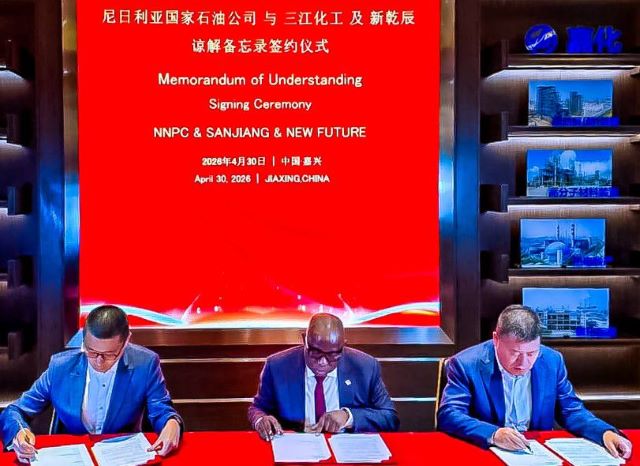
The latest MOU signed by the Nigerian National Petroleum Company Limited with China’s Sanjiang Chemical Company Limited and Xingcheng (Fuzhou) Industrial Park Operation and Management Co. Ltd to upgrade, operate, and expand the Warri and Port Harcourt Refineries has been strongly faulted by some stakeholders who questioned the $2.98 billion already spent on turnaround maintenance of the plants which yielded zero production.
There is strong criticism of the MoU that outlines a Technical Equity Partnership, where the Chinese companies will provide technology, expertise, and capital for the refinery projects despite NNPCL’s assurance that it will reduce costs and improve refinery operations.
Alliance for Economic Research and Ethics ((AERE Ltd/GTE)), a Nigerian organization focused on promoting economic research, ethics, and policy analysis, is in the forefront of opposition to the deal, saying there was no public accounting for the $1.5 billion already expended on the Port Harcourt Refinery contract, which operated at only 37.87 per cent capacity before shutting down within six months.
AERE Ltd/GTE, in its policy analysis report titled “Nigeria Refinery Crisis: $2.98 Billion Spent, Zero Functional Refinery,” shared with WorldStage noted that there was no account for the Warri Refinery which was rehabilitated at a cost of $897 million and reopened in December 2024, shut down just 31 days later.
AERE Ltd/GTE headed by Dr Dele Oye, former president, Organized Private Sector in Nigeria warned that the country could face another round of what it described as persistent failure in its refinery rehabilitation programme, adding that the NNPCL could incur further legal and financial liabilities if it proceeds with fresh refinery agreements without resolving existing contractual obligations.
According to the report, the rehabilitation of the Port Harcourt Refinery alone gulped about $1.5 billion through budget allocations, public funds, and borrowed financing, including support from Afreximbank, with an advance payment of $195 million made for the refinery project.
The breakdown of the funding included $200 million (13 per cent) from NNPCL’s internally generated revenue, $500 million (33 per cent) from Afreximbank debt financing, and $800 million (53 per cent) from federal government budget allocations. The report added that although Afreximbankrequired a private sector operator, the refinery was eventually operated by NNPCL.
The report further stated that the refinery rehabilitation contract was awarded to the Italian engineering company, MaireTecnimont, in March 2021, but questioned the effectiveness of the project despite the substantial financial commitments .
The group made reference to previous international arbitration disputes involving Nigeria, including the controversial Process and Industrial Developments case, stressing that poor contract governance had cost the country billions of dollars over the years.
The report also questioned the credibility of the Chinese partners being considered for refinery rehabilitation projects. It claimed that the firms lacked verifiable experience in crude oil refinery rehabilitation.
According to the document, neither of the Chinese partners has a proven global track record in refinery engineering comparable to established international EPC contractors previously engaged by Nigeria, which even failed to deliver on their contracts.
It also highlighted that both Chinese firms lack a track record in crude oil refinery operations, have limited financial transparency, possess no significant Nigerian project experience, and primarily operate in fine chemicals and industrial park management rather than refinery engineering.
The group therefore advised NNPCL against proceeding with the new refinery rehabilitation MoU on the grounds of technical incompetence, arguing that neither partner possesses credible crude oil refinery credentials, as both specialise mainly in fine chemicals.
It further warned that even established firms such as Tecnimontand Saipem had failed in similar projects, suggesting that partners with no comparable experience could perform even worse.
The report also cited the risks of recurrent project failure, potential legal and arbitral exposure, and the urgent need for comprehensive due diligence before proceeding with any agreement.
“The two companies have no technical and financial capacity to handle this type of project,” said Oye who also spoke on the issue in an interview on Arise TV May 4.
According to him, the information on the companies’ websites and disclosures on Hong Kong’s stock exchange revealed that one of them is running out of cash.
While Oye disputed the competences of these companies, he was of the opinion that the Ojulari-led NNPCL had positioned itself differently so far as transparency and accountability were concerned.
But on the MoU, he said “this is a mistake. “My recommendation is you do not go ahead.”