
































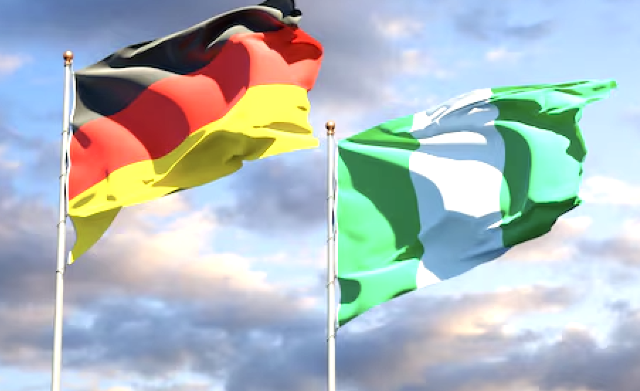
Germany has reaffirmed its commitment to development cooperation with Nigeria amid global economic pressures.
Daniel Krull, Consul General of Germany in Lagos who disclosed this on Monday night at a reception organised to mark German-Nigerian Business Day, said the cooperation is aimed at ensuring more efficient funding allocation and stronger private sector participation to drive sustainable growth.
The reception precedes the bilateral government negotiations on development cooperation between Nigeria and Germany scheduled to begin on Wednesday in Abuja.
According to Krull, officials from both countries will meet with relevant ministries to discuss areas of development cooperation and economic collaboration.
He said the idea behind the business event was to complement government-to-government engagements with private sector participation aimed at boosting trade and investment relations.
Krull explained that the reception also marked the partnership between Access Bank and the German Development Bank’s investment subsidiary, Deutsche Investitions- und Entwicklungsgesellschaft (DEG), through the establishment of a “German Desk”.
NAN also reports that Mr Fabian Bracher was introduced as the new Head of German Desk at Access Bank.
Krull said the initiative was designed to support German businesses seeking to operate in Nigeria by providing banking and advisory services tailored to their needs.
According to him, the desk is staffed by personnel fluent in both German and English and familiar with the cultures and business environments of the two countries.
“The programme is promoted by the German Federal Ministry for Economic Affairs and Energy as part of efforts to strengthen German-Nigerian business relations,” he said.
On development assistance, the consul-general said Germany was not withdrawing from foreign aid despite global economic pressures and budget constraints.
“Unlike America, we are not drastically dropping out of foreign assistance.
“This is not a strategy to reduce development cooperation, but a question of how to allocate portions of available funds more efficiently,” he said.
He added that Germany intended to involve the private sector more actively in development initiatives to achieve greater efficiency and impact.
Also speaking, Vice President of DEG, Volker Schwab said the bilateral negotiations between Germany and Nigeria held every two years provided an opportunity for both countries to determine priority areas for development funding.
Schwab said the German-Nigerian Business Day was organised to identify areas where public funding and private investment could complement each other for sustainable development.
He cited Siemens Energy’s vocational training investment in Nigeria’s energy sector as one of the flagship projects discussed at the event.
According to him, the German government agreed to match Siemens Energy’s investment in vocational training up to a ceiling of 2.5 million Euro.
“We support private sector-initiated programmes and scale them up to the needs of the host country.
“Germany’s cooperation focus areas in Nigeria include energy, construction and infrastructure, health and pharmaceuticals, digitalisation, industry and manufacturing.”
He also highlighted an initiative by German multinational, SAP to provide certified IT training opportunities for one million Nigerian students.
He described the initiative as critical to future economic growth and digital transformation in both countries.
“Digitalisation will be key for future prosperity,” he said.
Schwab further noted that Nigeria’s business environment still faced challenges, particularly in bureaucracy and customs processes, but expressed optimism over ongoing reforms and the country’s entrepreneurial potential.
“Nigeria might not be an easy one, but the challenges are comparable to other marketplaces.
“I am even more impressed by the dynamic energy and entrepreneurial spirit encountered here,” he said.