















































*India pledges support for Nigeria’s cotton, textile industry
WorldStage– Nigeria has reaffirmed commitment to strengthening bilateral and cooperation with India.
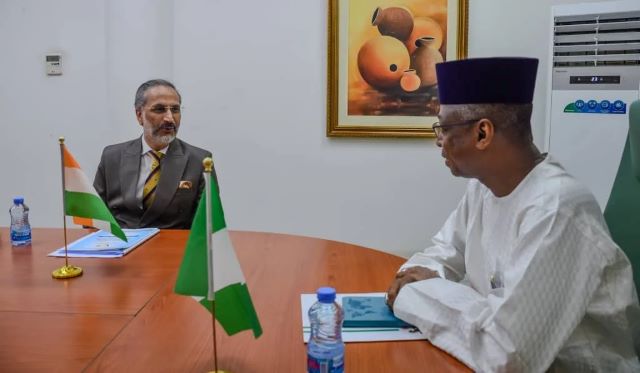
Amb. Dunoma Ahmed, Permanent Secretary, Ministry of Foreign Affairs stated this during a meeting with the High Commissioner of India to Nigeria, Abhishek Singh, at the Ministry’s Headquarters in Abuja.
A statement issued by Kimiebi Ebienfa, the ministry’s spokesman, said Ahmed expressed appreciation to Singh for the cordial relations between Nigeria and India.
He said that cooperation between both countries would focus on deepening ties ahead of the India-Africa Forum Summit scheduled to hold in New Delhi in May, 2026.
According to him, both countries are strategic partners united by shared democratic values and common aspirations for sustainable development and South-South cooperation.
He underscored the importance of the forthcoming BRICS and India-Africa Forum engagements in advancing multilateral cooperation among developing countries amid evolving global political and economic realities.
Ahmed reiterated Nigeria’s interest in increased Indian investments in key sectors of the economy, particularly manufacturing, agriculture, mining, renewable energy, and local value addition.
He further stressed the need for strengthened collaboration in security and counter-terrorism, especially through technological cooperation and defence capacity building.
Earlier, Singh briefed Ahmed about preparations for the BRICS Foreign Ministers’ Meeting slated for May 14 to 15, at the Bharat Mandapam in New Delhi.
Meanwhile, the India-Africa Forum Summit expected to convene African leaders, and senior officials later in the month.
Singh said, “ Nigeria, as a BRICS partner country and a major stakeholder in Africa, occupies a strategic place in India’s foreign policy engagement with the continent.
“The Government of India looks forward to Nigeria’s active participation at the meetings and in deepening cooperation between both countries in areas of trade, renewable energy, defence, industrialisation, agriculture, and technology.”
He further highlighted ongoing initiatives under the International Solar Alliance and Africa Solar Facility, including proposed renewable energy investments and enhanced developmental partnerships with Nigeria.
SUPPORT FOR COTTON, TEXTILE INDUSTRY
India has pledged support for Nigeria’s efforts to advance its cotton, textile and garment industry through technology transfer, investment partnerships, skills development and value chain integration.
Indian High Commissioner to Nigeria, Abhishek Singh, announced this on Thursday in Abuja at a Textile Meet and Business-to-Business (B2B) engagement themed: “Reviving the Textile Industry in Nigeria,”organised by the High Commission.
Singh said Nigeria and India shared a long-standing economic partnership built on complementary strengths, noting that Nigeria’s large population and growing textile demand positioned it as India’s strategic partner.
According to him, India is currently the world’s sixth largest exporter of textiles and apparel, with exports valued at 37.75 billion dollars in the 2024/2025 fiscal year.
“India and Nigeria share a long-standing economic partnership built on complementary strengths.
“Nigeria is Africa’s largest democracy with a growing population and rising demand for affordable textiles, while India is one of the world’s largest producers and exporters of cotton, yarn, fabrics and garments,” he said.
The envoy said bilateral textile trade between both countries remained below potential due to import restrictions, logistics costs, foreign exchange shortages and competition from cheaper Asian products.
He disclosed that Nigeria’s textile exports in 2024 stood at 25.69 million dollars, with India accounting for only five per cent.
Singh said India was ready to support Nigeria’s textile revival drive by encouraging Indian firms to establish ginning, spinning and textile processing facilities in cotton-producing states such as Katsina and Zamfara.
“Instead of only exporting finished fabrics, Indian firms can set up ginning, spinning and processing units in Nigeria’s cotton belts.
“This aligns with Nigeria’s Cotton, Textile and Garment Policy and reduces import dependence,” he said.
He added that India could also provide modern textile machinery, digital printing and dyeing technology, alongside technical training for Nigerian operators and manufacturers.
Singh said India was exploring partnerships between India’s National Institute of Fashion Technology and fashion institutions in Lagos to strengthen technical and design capacity in the sector.
He also announced plans for an India-Nigeria Bi-Monthly Trade Webinar Series in collaboration with the Abuja Chamber of Commerce and Industry (ACCI) to connect exporters and importers from both countries.
“We need to move the textile trade from transactional to transformational.
“India brings scale, cost efficiency and technical depth, while Nigeria offers market size and design innovation,” he said.
Earlier, President of the Nigerian Association of Chambers of Commerce, Industry, Mines and Agriculture (NACCIMA), Jani Ibrahim, said Nigeria’s textile industry remained critical to industrialisation, employment generation and export growth.
Ibrahim, represented by Pof. Adesoji Adesugba, NACCIMA focal person for India relations, said Nigeria’s textile imports rose to approximately 1.06 trillion naira in 2025 from 726.18 billion naira in 2024, while exports declined sharply within the same period.
“This is not merely a trade statistics; it is an urgent call to rebuild productive capacity,” he said.
According to him, Nigeria’s textile revival must focus on rebuilding the entire cotton-to-garment value chain, modernising machinery, improving skills development, expanding financing and strengthening local market access.
Also speaking, President of the Abuja Chamber of Commerce and Industry (ACCI), Emeka Obegolu, said the textile sector could drive jobs, innovation and economic transformation if properly developed.
Obegolu, represented by the chamber’s Director-General, Mr Agabaidu Jideani, added that the textile sector was once a cornerstone of Nigeria’s industrial economy, providing jobs, supporting livelihoods and contributing significantly to GDP.
“Today, we are presented with a renewed opportunity to restore that legacy and reposition the sector for global competitiveness,” he said.
Also speaking, Special Adviser on Investment Promotion to Abia Governor, Mr Greene Amakwe, described Aba as a major industrial hub capable of driving Nigeria’s textile and garment production.
“With the right investments in standardisation, training and infrastructure, Aba can transition from an informal production hub to a globally competitive manufacturing centre,” he said.