












































WorldStage Newsonline– Speaker of 9th Assembly and Chief of Staff to the President, Rt. Hon. Gbajabiamila has declared that since Nigeria returned to democracy 26 years ago, generations of members of the National Assembly and state legislatures across the country have done the complicated and often thankless job of building that legislative tradition.
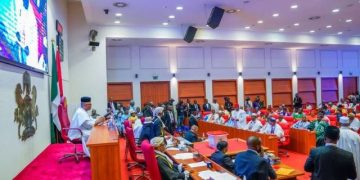
Gbajabiamila made the remark on Tuesday while speaking on the topic ‘Reflections on the Growth of the House of Representatives since 1999’ at the second Open Week programme of the House of Representatives at the National Assembly complex, Abuja. He added that these legislative houses have accomplished this task “without a roadmap, while navigating the unique realities of our political and cultural landscape.”
Before 1999, the former Speaker recalled, the country’s last experiment with legislative governance ended in 1993, and before then, in 1983.
As such, he said, there wasn’t much of an institutional memory to learn from; the conventions of parliamentary practice and procedure were a new experience.
According to him, the ongoing efforts by the administration of President Bola Ahmed Tinubu to restore a system of robust local government administration built on adequate financing, independence, transparency, and accountability, are critical to the future of the national parliament and must be supported by all who have served and continue to serve in this institution.
“In advanced democracies worldwide,” he referenced, “many of the quality-of-life issues that affect citizens daily are the responsibility of local governments. Everything from waste management to the regulation of local commerce, basic education, healthcare, and even community policing and security are local government functions.
“When local governments have the resources and independence to function as the constitution intended, then legislators are freed to legislate, develop policy, advocate for the greater good, and hold the executive to account. It is time to let legislators be legislators as God and the Constitution of our republic intended.
“If we cannot agree on the place of the local governments in our political system, and if we cannot collectively undertake to do what is necessary to ensure that the local government institution has the political and financial independence, and the administrative capacity to function optimally, then we must consider alternatives to formalise the additional duties that have now become the responsibility of the legislators.”
He added that the current system which forces legislators to spend more time seeking and pursuing resource opportunities to meet constituency needs and expectations rather than developing the capacities required to be effective as lawmakers, legislative advocates, policymakers, and overseers of the public purse, as the constitution demands, is untenable in the long term.
“If we expect legislators to provide social services in their localities, then, perhaps it is time for a national conversation to ensure our constitution reflects this, and the necessary resources are made available in a structured and efficient manner, allowing for transparency and accountability.”
The Chief of Staff to the President emphasized that a democracy without a strong legislature and a robust legislative tradition is a promise deferred.



