












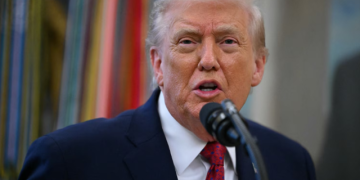










The global world was treated to another of The United States President, Donald Trump’s theatrics last July when he, either cynically or genuinely, said to Liberia’s President Joseph N. Boakai: “Such good English! Where did you learn to speak so beautifully? Were you educated? Where?”
In attendance during the Trump’s subtle exclamatory remark were four other leaders of African nations—Gabon, Guinea-Bissau, Liberia, Mauritania, and Senegal – who were being hosted by the American president.
Expectedly, the diplomatic verbal salvo attracted a lot of responses from every nook and cranny of the world’s territories with many commentators slamming it as Trump’s usual display of unconventional character complex. But rather than see it as an abuse, two sons of African origin but of global influence, Ambassador Rev. Ladi Peter Thompson and Dr. T. John Wulu Jr., would fathom some divine meaning and implications from the America leader’s statement.
According to the two, divine communication often arrives not with thunder, but in subtle, seemingly ordinary moments that require spiritual discernment. “One such moment occurred on Wednesday, July 9, 2025, at the White House, when U.S. President Donald Trump hosted leaders from five African nations—Gabon, Guinea-Bissau, Liberia, Mauritania, and Senegal,” they said.
Both Thompson and Wulu observed that what began as a routine diplomatic event quickly turned into something far more significant—especially for Liberia.
They said while President Trump praised the countries for their rich natural resources, cultural vibrancy, and strategic importance, it was an unscripted exchange with Liberian President Joseph N. Boakai that revealed a deeper message.
Reflecting on the comment, Rev. Thompson recalled Trump turning to President Boakai and saying “Such good English! Where did you learn to speak so beautifully? Were you educated? Where?”
To the casual observer, Thompson and Wulu said it may have seemed like a simple comment. “But to the spiritually attuned, it was more than that—it was a divine prompt.”
“While some critics and media outlets misinterpreted the moment as patronizing, those with discernment recognized it as a prophetic signal,” they reasoned.
Narrating that President Boakai responded with dignity and composure, they observed Liberia’s Foreign Minister, Sara Beysolow Nyanti, later affirmed that no offense was taken.
Rev. Thompson disclosed that at a prayer meeting in Maryland, USA, shortly afterward, Bishop Dr. Manon Gurley of Tabernacle Church lifted the moment in prayer, urging Liberians not to miss what she called a “divine distinction.”
Thompson quoted Bishop Gurley as citing 1Corinthians 1:27 – God uses the foolish things of the world to confound the wise- to emphasize that what appeared to be a diplomatic misstep may in fact have been a spiritual awakening, signaling that Liberia’s moment of divine favour had arrived.
Further reflecting on the comment, the Rev sees in Liberia a nation chosen for purpose, arguing it was not a political accident but a Kairos moment, a window of divine opportunity.
He said: “But with every open door comes responsibility. Liberia must guard against reactionary voices disguised as wisdom and instead embrace spiritual clarity over political calculation.
“As one thinker put it, “The most important part of communication is hearing what isn’t said.” Trump’s remark, perhaps unintended, emphasized something profound: Liberia’s Anglophone identity and deep historical ties to the United States set it apart in this group of nations.
“This was not just geopolitics. It was divine alignment.”
Connecting the White House diplomatic spectacle to Liberia’s significance in African context, Rev. Thompson evoked the happening as Liberia’s prophetic role, recalling how Liberia’s founding in 1822 by the American Colonization Society was no coincidence. “The nation was birthed with a dual purpose: to serve as a haven for freed African Americans and to become a light to the continent-spreading freedom, moral leadership, and religious liberty,” he added.
“Liberia’s mission,” he stated “was always bigger than its borders. And now, after decades of trials and transition, that calling is being reawakened. But this future cannot be built by looking backward. Liberia must now step boldly into a visionary path-one guided by principled, spirit-led, and innovative leadership.”
Away from the Trump’s controversial English language charge, Rev. Thompson and Dr. Wulu also referenced another priest’s comment to assert that by the Trump-Boakai’s scenario Liberia is primed for transition from aid to alignment as diplomatic gain from the White House drama.
“As Rev. Dr. George Zorbah of the All-Grassroots Pastors Association stated, Liberia does not need handouts!” They quoted.
According to them, this echoes President Trump’s emphasis on shifting from aid to trade-a policy position that, whether intentional or not, resonates with divine strategy.
“Liberia-with its vast natural wealth and a population of six million-has the potential to become one of Africa’s most peaceful, prosperous, and progressive republics.
“Nearly 45% of its population is under the age of 15, placing the country at a critical demographic and spiritual tipping point,” they further expatiated.
Making a call to action by Liberia, they said: “This moment calls not only for gratitude to God but also for strategic engagement. Liberia must follow up with concrete partnerships, particularly with U.S. leaders, to pivot from historic dependency to visionary collaboration.
“Liberia’s story must now be told-not as a tale of struggle and recovery, but as a testimony of destiny, rooted in shared values and a spiritual bridge between Africa and the West.”
Thompson and Wulu also demanded reviving the American Dream-Liberian Style, saying “the American Dream was never meant to be exclusive to the United States but that it’s a universal ideal, inspired by divine truths. Liberia was conceived as the African expression of that dream-a land of liberty, faith, and possibility.
“As Trump noted, ‘we speak the same language.’ That remark was more than linguistic, it was symbolic and spiritual. It pointed to shared heritage, vision, and destiny.”
They described the Trump’s comment that singled out Boakai among other African leaders present at White House scene as walking through the open door for Liberia.
“This is Liberia’s Kairos moment, a divine appointment that must not be missed. The door has been opened. The world may know Liberia’s past, but it has yet to see her glorious future. That future won’t be defined by aid or pity, but by trade, innovation, faith, and bold leadership.
“It’s time for Liberia to rise, not just as a nation, but as a beacon—a testimony to what happens when destiny meets divine timing,” Rev. Thompson and Dr. Wulu concluded.