




















































WorldStage Newsonline– The Lagos Chamber of Commerce and Industry (LCCI) has urged the Federal Government to guard against avoidable delays in the implementation of the 2025 budget themed “Budget of Restoration: Securing Peace, Rebuilding Prosperity”.
Mr Gabriel Idahosa, President, LCCI, gave the advice at the chamber’s first quarter news conference held on Thursday in Lagos.
He noted that the 2025 Budget is a comprehensive fiscal plan that aligns with critical national priorities with focus on security, infrastructure, education, health, and agriculture.
He said the budget also targeted macroeconomic stability and inclusive growth.
Idahosa said beyond the figures and assumptions, budget implementation was the key performance driver.
According to him, the 2024 budget implementation cycle extension to June 2025 should be closely watched to avoid such in the future, as it signalled weak budget execution.
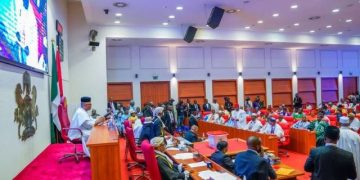
The LCCI president called on the National Assembly to expedite action on the appropriation debates to guard against avoidable delays in budget preparation and approvals.
This according to him is important in order not to stress the 2025 budget implementation expected to start in January.
Idahosa said to meet the budget’s ambitious N49.7 trillion projection, it had become urgent to improve Nigeria’s tax-to-Gross Domestic Product (GDP) ratio.
According to him, accelerating tax reforms, simplifying processes, and incorporating the informal sector are essential.
“Leveraging technology to expand the tax net, minimised leakages and fostering transparency will be critical.
“Fiscal discipline must complement these efforts to effectively manage the N15.81 trillion debt servicing allocation.
“Prioritising high-impact, self-sustaining projects and exploring alternative funding mechanisms, such as public-private partnerships, are crucial to keeping debts within sustainable limits.
“While the 2025 Budget outlines bold aspirations such as halving inflation and stabilising the foreign exchange rate, its realisation depends on robust policy implementation, sustained execution, and strategic alignment across all arms of government,” he said.
Idahosa said that in addressing the projected N15.81 trillion debt servicing burden, government must prioritise high-impact and self-sustaining projects.
The LCCI president said reducing inflation to 15 per cent and stabilising the exchange rate at N1,400/$1 required addressing structural challenges.
He noted that the continued rise in inflation was driven by poor crop production by farmers constrained by security challenges, transport costs, and the emerging impact of climate change.
Idahosa said beverages, produced mainly by local and multinational companies, had also recorded rising costs due to the challenging environment in which the manufacturers operate.
He added that livestock and poultry had also been strong drivers of food prices in the past year.
He stressed the need to resolve supply chain bottlenecks in food and energy, fast-track local petroleum production projects, and ensure alignment between fiscal and monetary policies to ease inflationary pressures.
“Nigeria is experiencing a severe food security crisis, with projections indicating that 33.1 million people will face high levels of food insecurity by mid-2025.
“This alarming situation is driven by economic hardships and record-high food inflation, which marginally eased to 39.84 per cent in December from 39.93 per cent in November.
“We call for the extension of the import waivers given to some critical imports, including agricultural input.
“We need more non-cash fiscal interventions in this area to boost food production and supply,” he said.
Addressing the country’s fluctuating petrol prices, Deputy President, LCCI, Mr Knut Ulvmoen, noted that several factors such as high cost of crude may impact final cost of petrol at the pumps.
Ulvmoen, however, projected that stability in exchange rate and more stable domestic refining an d supply may engender stability on fuel prices.
He emphasised the need for increased efficiency in local manufacturing and distribution thereby leading to increased production to lower prices of goods in the country.