





































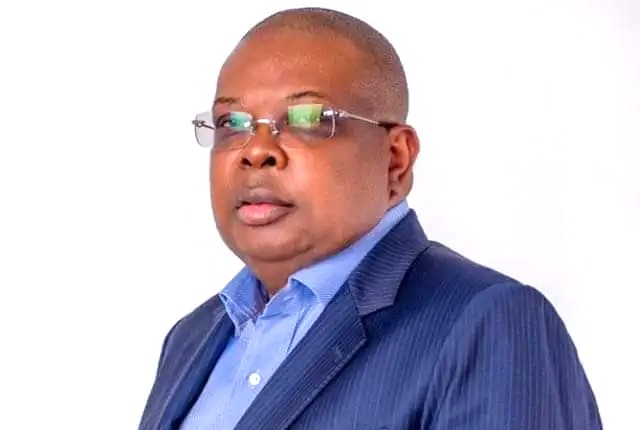
WorldStage– The Federal Government of Nigeria has successfully resolved the recent electricity supply challenges that threw several states into darkness over the past few days, the Minister of Power, Joseph Tegbe, disclosed this on Monday during a live television programme on TVC.
He assured citizens that robust measures are actively being implemented to sustain grid stability and prevent future disruptions.
The severe power outages, which heavily impacted the Federal Capital Territory (FCT), Lagos, and two other states, were triggered by a combination of operational hurdles.
Tegbe had previously noted that a vital, planned maintenance schedule at the Egbin Power Station—Nigeria’s largest thermal power facility—temporarily reduced available electricity.
The constraint was further exacerbated by acute gas supply shortages to key thermal stations and localized sabotage of critical transmission lines, leading to a drop in national grid capacity.
However, speaking on Monday, Tegbe confirmed the successful completion of the maintenance work, bringing vital generation units back online.
“We’ve sorted out this little challenge we had in the last few days,” the Minister stated.
“It was painful for most of you. But look, we fixed it. And we will ensure that that stability remains. My focus is to ensure grid stability,” Tegbe further assured.
The Minister verified that electricity has already been restored to several affected areas along the crucial Lagos corridor.
Following direct personal assessments, Tegbe confirmed that lights are back on in major hubs, including Ajah, Lekki, Ikoyi, Magodo, and Ikeja.
Looking ahead, Tegbe outlined the government’s long-term blueprint for total energy self-sufficiency, including the ambitious development of a $2 billion East-West Super Grid.
The massive infrastructure initiative aims to exponentially scale up the country’s functional grid capacity from its current average of 4,000 megawatts to an optimal 19,000 megawatts.
The administration also anticipates a significant injection of private sector participation within the next two to three years to bolster electricity transmission.
While acknowledging that full infrastructure build-out cannot happen overnight, the Minister projected that Nigeria will achieve completely stable power within a three-to-five-year horizon.
Appealing to the public for continued patience, Tegbe emphasized that the immediate priority remains optimizing existing infrastructure to secure a more consistent and reliable energy ecosystem for all Nigerians.






