
















































WorldStage Newsonline (Abuja)- The Federal Government of Nigeria and the United Nations (UN) have urged members of international community to take seriously concern for security and protection of humanitarian workers as well as civilian across the globe.
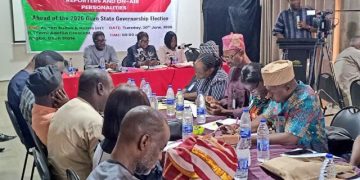
They made the call in a joint communiqué signed by the Minister of State for Humanitarian Affairs and Poverty Alleviation, Dr. Yusuf Tanko Sununu and the United Nations Resident /Humanitarian Coordinator on World Humanitarian Day, Mr. Mohammed Malick Fall at the World Humanitarian Day 2025 Nigeria held at UN House, Abuja.
The UN Secretary General Antonio Guterres, in WHD video message, also urged member nations of the international organization to respect all international laws protecting humanitarian/aid workers’ safety, lamenting that the UN had lost 22 staff members in attacks while carrying out their duty of saving others’ lives.
The programme, according to Sununu and Fall, is held to commemorate World Humanitarian Day 2025 and to honour the memory of “our colleagues, many of them national staff who have lost their lives helping people affected by conflict and disasters.”

“We urgently call for the protection of humanitarian workers and civilians across the globe. We ask that international humanitarian law is upheld, and protection provided to all those affected by conflict and disaster.
“We particularly call for the protection of women and girls, who are among the most vulnerable and most profoundly affected,” they further stated.
Sununu and Fall maintained that attacks on humanitarian workers and more, importantly, the people they seek to assist, must stop, noting that this year’s World Humanitarian Day came at a time when global solidarity with people in humanitarian need is at its lowest ebb.
They said international humanitarian financing is collapsing and that many of the most vulnerable people have little or no support.
Giving further disclosure on the challenges they stated: “In Nigeria, humanitarian needs are increasing, with food insecurity and malnutrition an unfolding disaster.

“Pipelines for food and nutrition that are lifelines for millions of people, especially children under the age of five, are severely disrupted, if not completely depleted. Millions of children are at risk of life threatening severe acute malnutrition (SAM).
“It is estimated that some 31 million people are food security insecure, over 10 million children under five are acutely malnourished, while 3.5 million are severely malnourished – 2.5 million of these in six states.”
To address the challenges, they recommended that urgent action is needed for about 400,000 SAM children, whose lives are in the balance if there is no immediate action to reverse the situation and save their lives.
“Globally, they added, “the humanitarian community is faced with unprecedented challenges. International humanitarian law is treated with disdain. Multilateralism has been replaced with short-term self-interest. And humanitarianism is under attack.
“The reform of the humanitarian system is urgently needed, building on the lessons learned over the last six decades, and the incredible know-how and experience of humanitarian partners, local and international.
In Nigeria, according to the Minister Sununu, humanitarian operations must become more efficient, accountable and transparent. “They must be led by the Government and implemented by local partners, to the extent possible, and funded through local resources supported by the international community,” he added.

Towards this end, Sununu declared that the humanitarian community in Nigeria commits to, fully supporting humanitarian response and action under the leadership of the government of Nigeria, coordinated with guidance by the Government of Nigeria; work with the government to ensure a transition from an internationally supported humanitarian operation to locally led action by the end of the transition period.
On the international side, he stated that the international community also commits to ensuring a transition from the direct delivery of humanitarian aid to an enabling role for local actors, preserving core functions, such as humanitarian diplomacy, coordination, protection, and upholding humanitarian principles.
Sununu and Fall also recognized that only development interventions, including disaster risk reduction and management, and anticipatory action could reduce the vulnerability and risks posed by hazards and disasters that threaten the welfare of Nigerians.
The government, represented by the Ministry of Humanitarian Affairs and Poverty Reduction, promised its commitment to promoting linkages between humanitarian, development and peace efforts through a nexus approach to ensure more durable, efficient and effective interventions.
They acknowledged the urgent need to act fast to save lives and assured that the government of Nigeria would increase funding of humanitarian interventions, institute transparency, and accountability framework the discharge of its coverage.
“Also, we urge all stakeholders and international and domestic partners to support us in providing additional funding and resources for food and nutritional support to end the suffering of millions of Nigerians.
“The government of Nigeria, together with humanitarian partners, will do its utmost to mobilize resources for the ongoing food and nutrition crisis.
“Together we will work to ensure a smooth transition to a locally led, implemented and resourced operation. At the same time, the government of Nigeria will ensure that humanitarian partners are able to work in accordance with humanitarian principles in conflict areas,” it ‘s further stated inthe communiqué.