




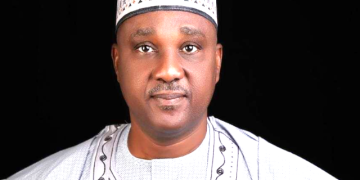









































WorldStage Newsonline– The Director General of the National Information Technology Development Agency (NITDA), Kashifu Inuwa, has called on African leaders to embed Artificial Intelligence (AI) at the core of their strategic, operational, and business models, positioning the continent as a global force in AI innovation.
Speaking at GITEX Africa 2025 in Morocco, Inuwa emphasized that AI-driven leadership is essential to unlocking new opportunities, accelerating development, and ensuring inclusive digital growth across Africa.
The aim of the panel session was to explore how data-driven and intelligence-led strategies can transform business models, optimize resources, and unlock new opportunities through AI-powered processes across various nations.
Inuwa noted that Africa, particularly Nigeria is emerging as a rising force in the global AI landscape, championing a people-first and strategy-led approach to AI development and governance.
The DG argued that to be effective in today’s dynamic environment, leaders must evolve into AI-driven leaders and leverage technology not just as a tool but as a partner in decision-making.
“AI is shifting the skills we value today, as well as the processes we use to do our daily work. To drive strategic leadership, you need to be an AI-driven leader and find a way to use AI as a tool to create co-intelligence—whereby you bring people and computers to work together to deliver your strategic vision as a leader,” he noted.
While urging leaders to combine AI with the unique strengths of their teams to deliver real business value, Inuwa said, “Strategy must always come first, and technology second.”
He outlined four principles for effectively utilizing generative AI: inviting AI to the table, maintaining human oversight, designing models with guardrails, and adopting a mindset of continuous improvement.
Inuwa explained that AI is invited to the table by assigning it roles in organizational tasks; human oversight is maintained to correct bias and misjudgment; guardrails are designed to ensure privacy, ethics, and inclusivity; and a mindset of continuous improvement is adopted by treating today’s AI as the least capable version that will be used.
However, he warned against the risks of deploying AI systems built on data that fails to represent the diverse realities of global societies. Stressing the need for digital visibility of all cultures and citizens, he cautioned, “If data doesn’t see a community, the system won’t see it either.”
Introducing NITDA’s approach to AI governance, Inuwa spoke about the Regulatory Intelligence Framework, which is anchored on three pillars: Awareness, Intelligence, and Dynamism.
“In our approach to regulating AI in governance, we have a framework called the Regulatory Intelligence Framework. As a regulator, we need to be aware of the environment; we need to be dynamic because things change; and we need to be intelligent—we need to know the data and make sense out of it,” he disclosed.
“We have two approaches: the first is rule-based, where you establish certain guidelines and expect compliance. The second is non-rule-based, which allows for building use cases and, based on those, putting guardrails in place and agreeing on best practices. This is often the most effective approach when it comes to AI governance,” he added.
Envisioning Africa’s AI future over the next five years, Inuwa painted a visionary picture of a continent integrating AI to solve real-world challenges across all economic sectors, thereby leapfrogging development gaps.
Inuwa firmly asserted that by augmenting human capability with AI, the continent can unlock unprecedented levels of innovation, efficiency, and inclusive growth.
“We missed the first, second, and third industrial revolutions—but this fourth one, we must lead, not just follow,” he concluded.
Other industry leaders who shared their experiences and insights during the panel session included the Special Envoy on Technology for the Republic of Kenya, Philip Thigo; CEO of Pesalink, Gituku Kirika; and Head of Africa at OpenAI, Emmanuel Lubanzadio.