





















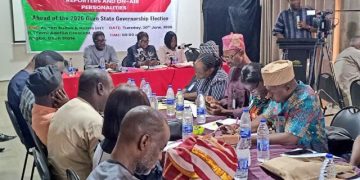














WorldStage Newsonline– The Federal Government’s commitment to build a foundation for a sustainable blue economy ecosystem received a boost this week as stakeholders converged at the Hotel Presidential, Port Harcourt, Rivers State to discuss the necessity of execution of a sustainable Nigerian Blue Economy in view of the current socio economic climate in Nigeria.
The three day forum (26-28 November, 2024) tagged Sustainable Nigerian Blue Economy – Ecosystem Conference organised by Alfe City Institution with the support of the Ministry of Marine and Blue Economy attracted top officials of the ministry from Nigerian Port Authority (NPA), Nigerian Shippers’ Council (NSC), National Inland Waterways Authority (NIWA), along with other maritime sector’s operators who deliberated on the historical and novel innovative aspects of ocean business that make the Blue Economy the solution to Nigeria’s economic challenges.

Other issues addressed at the forum were the immediate legislative requirements necessary for a sustainable Nigerian Blue Economy; the framework for the most effective administration architecture that would guarantee a sustainable Nigerian Blue Economy; possible creation of a blue print for a Bill to establish a specialized autonomous body to be called the Nigerian Blue Economy Commission that will be responsible for the day to day administration of the Nigerian Blue Economy ecosystem.
Notable speakers at the forum include Engr. Danny Abboud, MD/CEO, Hitech Construction Company Limited represented by Dr. Eugene Itua, Lead, Environmental and Social Safeguards, Lagos-Calabar Coastal Highway; Angus Obinna Chukwuka, ESQ , PH President , Admiralty Lawyers Society of Nigeria; Prof Ibibia Lucky Worika, a Professor of Comparative Petroleum & International Environmental Law and Policy among others.
Dr. Eugene Itua in his presentation on Engineering Behind The Lagos-Calabar Coastal Highway Project reflected on the environmental considerations, sustainability and potential contribution to a sustainable Nigerian Blue Economy, saying the highway is anticipated to contribute between $10 billion to $12 billion annually to Nigeria’s GDP within the next ten years, showcasing its potential as a major driver of economic growth.

“The Lagos-Calabar Coastal Highway Project is a transformative initiative aimed at enhancing regional connectivity and trade. By prioritizing environmental considerations and sustainability, the project aims to contribute positively to Nigeria’s blue economy,” he said.
“The success of the Lagos-Calabar Coastal Highway Project in contributing to a sustainable blue economy hinges on robust collaboration among all stakeholders and a commitment to ongoing monitoring and adaptive management.”
Mr Angus Obinna Chukwuka in his presentation: “The Nigerian Maritime Legal Landscape And Its Readiness For Integrating A Blue Economy Regime” said the Nigeria’s blue economy preceded President Bola Tinubu’s assumption of office , but the creation of the ministry of Marine And Blue Economy was a very strategic one which will afford Nigeria the opportunity of paying adequate attention to the marine sector and thereby turning Nigeria into a world economic power.

“But this will involve serious research efforts , legal and institutional reforms , Observance of international best practices, sincerity of purpose and determination,” he said .
Mr Soji Adeleye, the CEO of Alfe City Institution in his presentation described the Nigerian Blue Economy Ecosystem as the manifestation of the resources of the ocean in its Exclusive Economic Zone (EEZ) , the goods and services conveyed in and out by ships through its Seaports, the business of shipping, the infinite renewable energy source – thermal waves.

“It’s the sustainable management with the potential to quadruple the national GDP exponentially in the medium term as projected by experts from the current 407 billion dollar to 1.5 trillion USD for the benefit of the people that is the prospective Nigerian Blue Economy Ecosystem,” he said.
He advocated for a policy that will use the Blue Economy as a tool to build a sustainable foundation for an economy that has none.

“We have in the course of the last four years provided the policy foundation for this engineering – this maximalist interpretation of Nigeria’s own Blue Economy is crucial to meeting the exigencies of the moment,” he said.
“This informed the bringing of all elements of the Blue Economy together for this ecosystem conference to drive the policy formulation and legislation.

“We believe a potential construction of ten new Ports, Port Cities as part of this broad engineering – in effect ten new Lagoses would accelerate coastal development, create new centers of economic growth, create avenue for new transportation infrastructural development, provide millions of employment opportunities.”
On the need for the creation of the Nigerian Blue Economy Commission (NBEC), he said the agency would be a regenerative with a power to help shape the Nigerian future economic landscape – articulate and supervise the technology, the finance that would be needed to build a new integrated economy.

“A Sustainable Nigerian Blue Economy can only thrive if run by a twenty first century autonomous entity that could be proactive, responsive – a octopus like Institution that is research driven, financial and technology savvy that can advocate, proffer solutions, supervise and monitor development in the ocean, along the coast and all that derived from there.
“A Nigerian Blue Economy Commission should be responsible for supervision of compliance of actors in the Ecosystem, the enforcement of standard, the planning for future trends and outlook. Sustainability is at the core of Blue Economy. The Commission should supervise and uphold sustainability requirements and reflect this in practice as the success of the future Nigerian economy is dependent on a sustainable implementation of a Nigerian Blue Economy.”



