









































WorldStage– The Federal Government recorded a N1.44tn decline in gross oil revenue in the first half of 2026, even as international crude oil prices surged by 41.23 per cent in the second quarter of the year, Budget Office of the Federation disclosed.
An analysis of the Second Quarter and Half-Year 2026 Budget Implementation Report revealed that gross oil revenue fell to N7.88tn between January and June 2026, down from approximately N9.32tn recorded during the corresponding period in 2025.
This represents a 15.45 per cent year-on-year contraction in oil earnings.
More concerning for fiscal planners is the widening gap between projections and actual collections.
The N7.88tn realized in the first six months of the year achieved only 42.22 per cent of the government’s prorated half-year target of N18.65tn, leaving a massive oil revenue shortfall of N10.78tn.
This steep drop occurred against the backdrop of a booming international oil market. Driven largely by geopolitical tensions—including the conflict involving the United States and Iran—international crude prices averaged $104.52 per barrel in the second quarter of 2026, compared to $74 per barrel in the second quarter of 2025.
The $30.52 per barrel increase represents a 41.23 per cent surge, placing actual market prices 61.17 per cent above Nigeria’s 2026 budget benchmark of $64.85 per barrel.
Despite this favourable global price windfall, Nigeria failed to translate higher crude valuations into increased treasury inflows, largely because domestic oil production continued to lag behind budgeted targets.
The oil revenue slump heavily weighed down overall federation earnings in the first half of the year.
According to the report, total gross federally collected revenue stood at N19.2tn between January and June 2026, falling 42 per cent short of the prorated target of N33.2tn and creating an aggregate revenue deficit of roughly N14tn.
Oil receipts accounted for nearly 78 per cent of this overall shortfall.
International oil prices averaged $104.52 per barrel in the second quarter of 2026—up 41.23 per cent from the $74 recorded in Q2 2025 and 61.17 per cent above the 2026 budget benchmark of $64.85 per barrel.
However, domestic crude production stayed below target. Although average daily output rose from 1.55 million barrels per day in Q1 to 1.72 million barrels in Q2, it remained 120,000 barrels short of the 1.84 million barrels per day budget assumption.
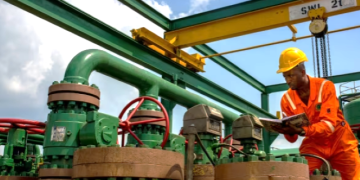
The Budget Office noted that crude theft, pipeline vandalism, infrastructure deficits, and underinvestment prevented Nigeria from turning higher global prices into stronger fiscal inflows.
Petroleum profit and gas taxes posted the largest shortfall, generating N2.92 trillion against a N11.96 trillion projection—a N9.05 trillion gap that equalled 75.62 per cent of expected receipts in that category.
Direct crude and gas sales brought in N285.64 billion against a budgeted N1.17 trillion, while oil and gas royalties contributed N4.07 trillion. Gas-flaring penalties added N324.56 billion, and pipeline fees and miscellaneous oil receipts reached N444.73 billion.
While macroeconomic indicators showed some resilience—such as real GDP growing by 4.43 per cent in Q2 and gross external reserves closing the half-year at $51.39bn—the persistent underperformance of oil revenues continues to strain budget execution and force reliance on borrowing to finance fiscal deficits.The Budget Office recommended stronger security for oil infrastructure, better operational efficiency, higher investment, and stricter enforcement of royalty and statutory payment obligations to close the revenue gap.