



































*Tasks African governments on agricultural structural transformation
The African Development Bank (AfDB) Group has provided about 42 million people with access to improved water and sanitation through its African Development Fund (ADF) initiative.
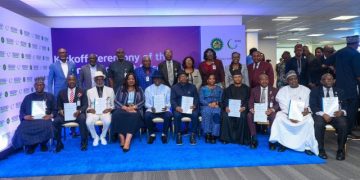
Dr Akinwumi Adesina, the President of the AfDB Group, said this at an event to mark the ADF at 50 on Thursday in Accra, Ghana.
The News Agency of Nigeria (NAN) reports that the ADF is the concessional financing window of the Bank Group that provides low income Regional Member Countries (RMCs) with concessional loans and grants.
The fund also provides guarantees as well as technical assistance for studies and capacity building in support of projects and programmmes that spur poverty reduction and economic development.
He said the fund had also financed no fewer than 2,750 projects in the last five years on the continent.
According to him, ADF has connected 15.5 million people to electricity, supported 74 million people with improved access to agriculture, 50 million people with access to transport.
”Life is not equal, yet all lives must be equal. Everyone has a right to a decent live.
”ADF has been expanding the lives of the people.
”The fund has been working to reduce inequality, access to electricity.
”The most important part of the bank is the development. I believe that you put us here to fast track Africa’s development, because we are way too behind,” Adesina said.
Some of the ADF beneficiaries said the fund has assisted them to improve their standard of living.
Ms Selena Avevor, Chairperson of the Obiman Women Association, a smallholder empowerment association in Ghana, said the fund had assisted them to empower about 50 rural women.
Avevor said the association had trained women on different skills such as soap making and baking with the assistance of the ADF.
”We had 20 women that we were training before but when the fund started supporting us, we increased the number to 50 rural women.
”ADF built a hostel for us, sunk borehole and helped us to have an office.
”We are looking that we will get more women to train, have higher markets with the support of the ADF,” she said.
Ms Clara Shuaibu, also a benefiary of the Savannah Investment Programme (SIP) funded by the ADF, said the fund provided birds and feeds for her to start a poultry business.
”I am now an employer of labour because of the ADF,” she said.
Some of the ADF contributing countries commended the Bank for utilising the fund.
Mr Kentaro Ogata, the Deputy Vice Minister for International Affairs, Ministry of Finance, Japan, commended the passion of the AfDB toward addressing Africa’s challenges.
”We will like to see African countries grow and achieve sustainable future.
”We may be able to contribute the funding but we don’t have the expertise, we will work together with those with the knowledge like the AfDB”.
Ms Jessica Isaacs, Senior Advisor USA, AfDB, said that ”we want to partners with Africa for stable and sustainable growth.
”That is why we choose to partner with the ADF because we believe in resilient, inclusive Africa.”
Ms Sigrid Schenk-Dornbusch, the Head of Division, Regional Development Bank, Federal Ministry for Economic Cooperation and Development, Germany, said the country would stand fast with the fund to make the continent better.
NAN reports that the ADF was created in 1972 and became operational in 1974.
Some of the ADF eligible countries are Benin, Burkina Faso, Chad, Madagascar, Gambia, Guinea, Guinea-Bissau and Burundi, among others.
TASKS AFRICAN GOVERNMENTS ON AGRICULTURAL STRUCTURAL TRANSFORMATION
Dr Martin Fregene, Director, Agriculture and Agro-Industry, African Development Bank (AfDB) has tasked the African governments on agricultural structural transformation and increased finance to mitigate food challenges in Africa
Fregene stated this at the virtual forum of Technologies for African Agricultural Transformation (TAAT), a flagship programme of the African Development Bank, the second edition on Thursday.
He said Africa had received some incredible impacts from extraneous shocks to its food supply from factors such as COVID-19 and war in Ukraine.
“Africa is having a shortfall of 30 million tonnes of cereals, mostly Wheat and Maize due to the war in Ukraine.
“Why don’t we do the structural transformation required to make our agriculture market-led, in the sense that it is the market that provides farmers inputs, off takes from farmers and ensures they get extension services where they use the best technologies needed for production, like the rest of the world, Europe and North America.
“There is a market in Africa for cereals for food. The market can handle everything about mechanisation, production and finance,” he said.
Fregene stated that to get the private sector on board four things must be put in place which were changes in certified seeds required regulation, increased finance, improved infrastructure and fast tracked method of registering new varieties and inputs as well as technologies.
“We must have a seed council that would test certified seeds for purity and germination. So we need to strengthen the seeds system and national regulatory agencies.
“We need not just laws but enforcement to ensure that only certified seeds are sold and this will encourage the private sector to key in.
“Also, on fertilisers, out of six brands sampled in Nigeria, only one had the required nutrients the NPK 12:12:17, quality control has to be enforced .
And, not just that but ensure fertiliser becomes a strategic commodity such as rice and wheat such that it is giving priority at the port to reduce demurrage before it is offloaded,” he said.
Also, Dr Innocent Musabyimana, Head, TAAT Clearinghouse, said the TAAT programme connects innovative agricultural technologies from research institutes to private sector partners for adoption and scaling.
“This is one of the mechanisms we are using to transform agriculture across the continent.
“We are bringing all the technologies that are proven, ready to be used into the hands of millions of farmers for deploying it,” he said.
Musabyimana noted that TAAT has been implemented in 28 countries in the continent with 160 proven, high performing technologies by partnering government, private sectors and farmers.
“TAAT provides access to quality seeds that translate to quality yields for farmers. We have increased productivity by providing access to these technologies.
“We want to reach more farmers by working with the private sector as we have proven technologies for Wheat, Maize, Rice and Soybeans.
“So that as Africans we can mitigate the effects of the ongoing Ukraine war on African food production,” he said.
Sharing his success story, Mr Kola Adeniji, a farmer, said working with TAAT has led to an increase in cassava production among others.
The News Agency of Nigeria (NAN) reports that some of the 10 proven technologies introduced by TAAT included Hermetic bags for safe storage of grains, Flour milling and blending systems, Integrated Management of Insects, Diseases and Weeds.
Others are Pre-Cooked Beans for Consumer Convenience, Seed dressing of common bean with fungicide and insecticide, Fall armyworm control in maize production; e.g. FORTENZA (TM) Duo, Aflatoxin management (e.g. Aflasafe atoxic fungi) among others.




