



































…UNFPA hails LASG push in demographic dividend planning
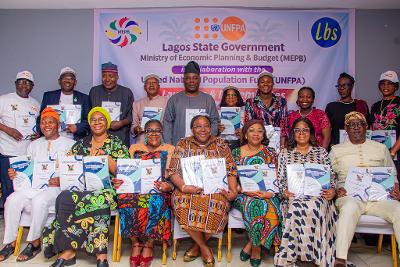
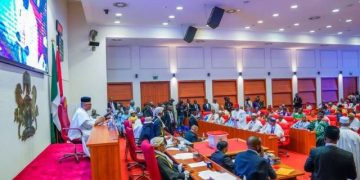
PIX_front row: Commissioner for Economic Planning and Budget represented by the Permanent Secretary, Mrs Olayinka Ojo (middle), flanked by her counterparts and other stakeholders, during the unveiling and dissemination of Demographic Dividend Reports for Lagos State, held in Ikeja.
Lagos State Government has intensified efforts to align its budgetary allocations with demographic dividend priorities, in a strategic move to harness the potential of its growing youth population and accelerate economic development.
The Commissioner for Economic Planning and Budget, Mr Ope George stated this at the launch of the state’s Demographic Dividend Reports in collaboration with the United Nations Population Fund (UNFPA) in Ikeja, Lagos.
The reports launched on Wednesday are Integration of Demographic Dividend into the Budgetary Process and Development Plan of Lagos State and the Lagos State Demographic Dividend Monitoring Index.
Goerge, represented by the Permanent Secretary, Mrs Olayinka Ojo, said the reports would provide evidence-based guidance for government planning and budgetary decisions, urging ministries, departments and agencies (MDAs) to incorporate the identified priorities into their programmes and spending plans.
She stressed that the reports should not become documents that are launched and subsequently abandoned but should serve as practical reference materials for government officials in planning and resource allocation.
“There is nothing that helps planning like evidence-based planning. When you have something to reference, something to draw from, it will be a disservice to Lagos State if, after launching this report, we close it off without making reference to it,” she said.
The Permanent Secretary explained that the state needed to be deliberate about directing resources towards areas capable of improving the wellbeing and economic prospects of its population, particularly young people.
She recalled that the state had begun considering a realignment of its spending priorities in 2024, following growing recognition of the importance of demographic dividend planning.
Ojo also highlighted the pressure Lagos faces in providing opportunities and infrastructure for its growing population, noting that the state’s ability to manage its population structure would significantly influence its future economic viability and development.
She urged planners and administrators to ensure that the findings of the reports informed future budget preparations, reviews and government investment priorities.
During a technical session presentation, Senior Research Fellow, Health Policy Training and Research Programme, University of Ibadan, Dr Oyeteju Odufuwa, explained that the demographic dividend framework was organised around key development priorities, including health and wellbeing, education and skills development, employment and entrepreneurship, good governance, social protection and migration.
She disclosed that the health and wellbeing pillar identified five investment options and 23 activities, while education and skills development had five investment options and 22 activities.
Similarly, employment and entrepreneurship had five investment options and 17 activities, while good governance contained four investment options and 16 activities.
According to her, the activities were developed through a collaborative process involving relevant state actors and stakeholders during a five-day workshop.
Odufuwa explained that the budget integration exercise was designed to map the activities in the demographic dividend roadmap against the state’s chart of accounts to establish how government resources aligned with the identified priorities.
She said the process would provide a framework for systematically tracking the allocation of resources to demographic dividend activities and promote policy coherence across government institutions.
The researcher further disclosed that Lagos had made significant progress in integrating demographic dividend planning with its development framework and monitoring index.
Odufuwa said that demographic dividend was not automatic but required intentional policies and investments to translate population potential into economic gains.
Also speaking, the United Nations Population Fund (UNFPA) representative, Mrs Jaiyeola Ayanbadejo, described Lagos as a leading state in demographic dividend planning, commending its sustained partnership with the organisation.
She said demographic dividend was an important framework for connecting population issues with development outcomes and youth empowerment.
“Demographic dividend is not automatic, and of all the states that UNFPA supports in Nigeria, Lagos State has been the centre of excellence,” she said.
Ayanbadejo recalled that the partnership with Lagos on demographic dividend initiatives began around 2015, leading to the development of a roadmap, its integration into the state’s development plan and the establishment of a demographic dividend monitoring index.
She explained that the framework also connects UNFPA’s transformative goals of ending preventable maternal deaths, meeting family planning needs and eliminating harmful traditional practices with broader development objectives.
She commended the Lagos State Government for its commitment to the process and expressed the organisation’s readiness to sustain its partnership with the state.