



































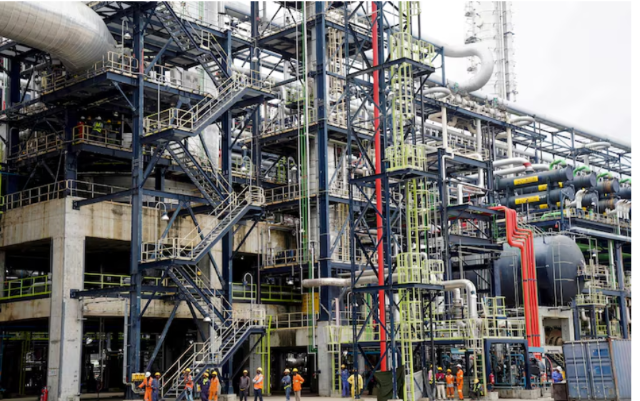
WorldStage — Dangote Group is targeting an expansion of its petroleum refinery capacity to 1.4 million barrels per day and fertiliser production to 12 million metric tonnes annually under its vision 2030 growth strategy.
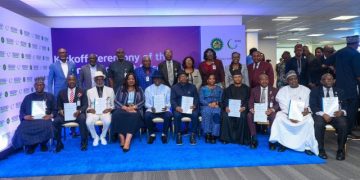
Fatima Aliko-Dangote, Group Executive Director, Commercial Operations, disclosed this on Wednesday at the Dangote Group Special Day at the 2026 Lagos International Trade Fair.
She said the expansion plans were part of the group’s commitment to strengthening local production, promoting industrial self-reliance and positioning Africa as a major player in global trade.
Aliko-Dangote said the group was also working to expand polypropylene production to serve the packaging, textile, automotive, medical and construction industries.
She said the group’s transition from trading to manufacturing was driven by the conviction that sustainable economic growth depended on the ability to produce locally.
“Manufacturing creates jobs, develops skills and transforms raw materials into higher-value products,” she said.
She noted that Dangote cement currently had an installed capacity of 55 million tonnes annually across Africa, while its refinery, fertiliser operations and other industrial businesses were contributing to the continent’s industrial development.
Aliko-Dangote said the group’s investments extended beyond Nigeria, with ongoing projects including a major refinery in Lamu, Kenya, an integrated fertiliser and industrial complex in Ethiopia, and a refined petroleum products corridor linking Djibouti and Ethiopia.
She explained that the projects were designed to strengthen regional supply chains, support food and energy security, create employment and expand intra-African trade.
The group executive director also disclosed that the Dangote group was investing about 140 million dollars in a tank farm and regional pipeline project in Namibia.
She said the project, located on approximately 70 hectares near Walvis Bay, was expected to provide about 240 million litres of storage capacity for diesel and petrol.
According to her, the investment is expected to position Walvis Bay as a strategic energy gateway, with a planned inland pipeline and distribution network connecting Namibia to Botswana, Zambia, Zimbabwe, Malawi and the Democratic Republic of the Congo.
She said the group’s vision 2030 strategy was focused on consolidation, industrial expansion and cross-border investments to strengthen Africa’s productive capacity.
Aliko-Dangote said Africa’s economic transformation must be anchored on local production, industrial self-reliance and world-class infrastructure.
“For too long, our continent has exported raw materials and imported finished goods.
“Vision 2030 seeks to reverse that pattern by ensuring that more African resources are processed in Africa, by Africans, for the benefit of Africans,” she said.
She added that the Dangote petroleum refinery was also supporting Nigerian contractors, engineers, technicians and service providers, while promoting skills development, technology transfer and stronger local supply chains.
Meanwhile, Mr Leye Kupoluyi, President, Lagos Chamber of Commerce and Industry (LCCI), said that sustainable economic growth required increased domestic value addition and large-scale investments in production.
Kupoluyi said the Dangote group had demonstrated the importance of indigenous investments in reducing import dependence and strengthening Nigeria’s productive capacity.
He cited the group’s cement, fertiliser and consumer goods operations, as well as its 650,000-barrel-per-day petroleum refinery as significant contributions to the country’s industrial development.
He said the refinery had strengthened Nigeria’s external trade position through increased domestic refining and reduced dependence on imported petroleum products.
According to him, the group’s investments also create opportunities for micro, small and medium-sized enterprises (MSMEs), distributors and other businesses operating across its value chains.
Kupoluyi however, urged the government to address structural challenges, particularly unreliable electricity supply, transport logistics and unpredictable fiscal policies, to reduce the cost of doing business.
“To replicate the Dangote group model across other sectors, government must urgently address structural bottlenecks, specifically reliable power, transport logistics and predictable fiscal policies,” he said.
He said the LCCI remained committed to promoting private enterprise, influencing progressive policies and creating opportunities for businesses through platforms such as the Lagos International Trade Fair.
The 40th edition of the Lagos international trade fair has the theme: “Connecting Businesses, Creating Value”.






