












































WorldStage– The administration of President Bola Tinubu has committed ₦450 billion to agricultural financing programmes aimed at strengthening national food security, increasing domestic crop production, and empowering small-holder farmers across Nigeria.
The announcement was made on Sunday in a statement issued by Dele Alake, the Minister of Solid Minerals Development and spokesperson for the All Progressives Congress (APC) Presidential Campaign Council.
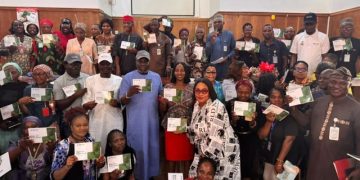
According to the statement, the multi-billion-naira intervention, implemented through the Bank of Agriculture (BOA), has already reached more than 500,000 small-holder farmers across 16 states, including over 70,000 women.
The funding is divided into two core pillars designed to tackle both input shortages and post-harvest price instability: Renewed Hope Small-holder Support and Value Chain Fund (₦250 billion) to be administered through farmer aggregation companies.
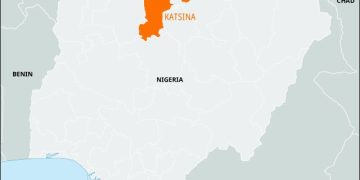
This fund provides financing, extension services, and market linkages, with the initiative having so far facilitated the distribution of roughly 2.5 million bags of fertiliser and 300,000 bags of certified seeds across states including Kaduna, Kano, Katsina, Niger, Borno, Gombe, Taraba, Adamawa, Yobe, and Bauchi.
According to Alake, the government aims to scale this outreach to two million farmers and distribute over 10 million bags of fertiliser.
The other core pillar is the Guaranteed Minimum Price Programme (₦200 billion), designed to protect farmers from market volatility and distress sales.
Minister Alake said BOA has utilized this fund to procure approximately 170,000 metric tonnes of staple commodities—including maize, rice, sorghum, and cassava—to stabilize local food markets.
Beyond direct financing, Alake noted that President Tinubu has approved a proposed ₦1.5 trillion recapitalisation of the Bank of Agriculture to expand credit access to underserved rural communities and support the cultivation of 500,000 hectares of farmland.
The administration is also executing targeted value-chain interventions. These include an Onion Financing Programme covering 70 per cent of input costs for over 11,800 farmers, a Ginger Recovery Programme in Kaduna State, and the deployment of 1,571 tractors across 23 states under the national mechanisation drive.
Also, a ₦385 billion clean-energy agricultural initiative is set to distribute 100,000 solar-powered irrigation pumps and 44,000 electric cargo tricycles to 500,000 farming families.According to the council, these comprehensive measures reflect the federal government’s resolve to transition agriculture into a primary driver of economic growth, job creation, and sustainable food self-sufficiency.