































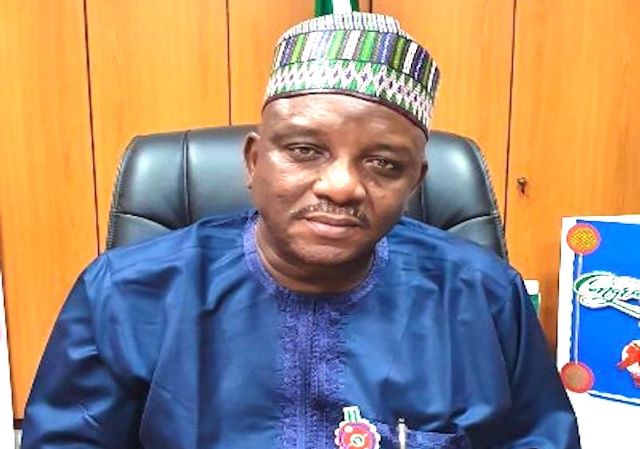
WorldStage— The Chairman of the Economic and Financial Crimes Commission (EFCC), Ola Olukoyede, has revealed how a former Nigeria’s Minister of Power, Saleh Mamman, diverted ₦29 billion out of ₦32 billion meant for critical national power infrastructure to acquire luxury real estate.
Olukoyede made the disclosure while highlighting the gravity of corruption within the public sector and explaining how systemic greed directly undermines national development.
According to the EFCC boss, the funds were explicitly allocated by the Federal Government to finance the Zungeru and Mambilla hydroelectric power projects, which were engineered to significantly boost electricity supply across Nigeria.
Instead of funding the infrastructure, Mamman allegedly diverted the money for personal enrichment, with Olukoyede remarking that the former minister siphoned ₦29 billion out of ₦32 billion to acquire properties.
The fraud involved ministry officials, proxy companies, and BDC operators, leading to the acquisition of assets like the Walijam Apartments, Bloom Luxury Suites, and mansions in Wuse 2, Abuja.
Following an EFCC investigation and prosecution, Justice James Omotosho sentenced Mamman to a consecutive total of 75 years in prison and ordered the forfeiture of the acquired properties to the Federal Government.
Olukoyede emphasized that the case serves as a warning against compromising national infrastructure for personal gain.
The fallout from the financial mismanagement has severely crippled the nation’s energy outlook, with the 700-megawatt Zungeru plant suffering structural delays, while the 3,050-megawatt Mambilla project in Taraba State has been reduced to a monument of waste.
Conceived over five decades ago, the Mambilla mega-dam remains largely on paper, paralyzed by legal entanglements and under-the-table payouts.
The financial wreckage extends beyond domestic theft. Legal battles tied to fraudulent contract awards sparked multi-billion-dollar international arbitrations.
Nigeria recently secured an arbitration victory at the International Chamber of Commerce (ICC), which threw out a $3.38 billion compensation claim filed by Sunrise Power and Transmission Company.
The tribunal ruled that the underlying contracts were deeply tainted by corruption and signed by former officials who completely bypassed presidential approvals.
While these legal and courtroom victories save the country from paying billions in fraudulent claims, the domestic damage remains stark.
Regional leaders, including the North East Governors Forum, continue to vocalize their frustration over the abandoned infrastructure.
Decades of policy inconsistency, regulatory failures, and institutional greed have deprived millions of citizens of stable electricity.
For local communities whose lands were mapped out for demolition decades ago, the stalled projects represent a legacy of broken promises.
Moving forward, the government faces the immense challenge of restoring global investor confidence and securing transparent financing frameworks to finally light up the country.