












































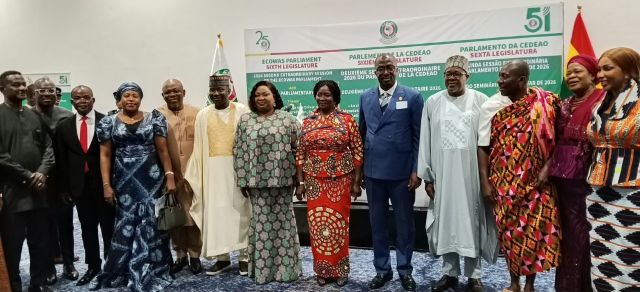
By Abiodun Folarin
WorldStage– The Economic Community of West African States (ECOWAS), has warned that climate change could drive the number of internally displaced people in the sub-region to nearly 32 million by 2050, as environmental degradation increasingly compounds humanitarian and security challenges.
The ECOWAS Commission President, General Birman Diop, represented by the Commissioner for Human Development and Social Affairs, Prof. Nassirou Bako-Arifari, gave the warning on Tuesday at the Second 2026 Joint Parliamentary Seminar in Accra, Ghana.
The three-day seminar, holding from September 21 to 23, is themed: “Climate Change as a Driver of Environmental Degradation, Population Displacement and Rising Insecurity in the ECOWAS Region.”
Diop said the scale of climate related risks had moved beyond an environmental concern to become a development, humanitarian, peace and security issue with implications for regional stability.
He said West Africa was particularly vulnerable to the effects of climate change, including rising temperatures, changing rainfall patterns, prolonged droughts, desertification, coastal erosion, flooding and the degradation of forests and farmlands.
According to him, more than two million people were displaced in 2024 as a result of natural disasters linked to climate change, while more than seven million people were affected by flooding, resulting in damaged roads, homes, health and educational infrastructure, farmland and food reserves.
He further stated that the combined effects of climate change and other sources of insecurity and vulnerability between 2025 and 2026 had resulted in more than 12 million internally displaced people across West and Central Africa, with women and children accounting for 80 per cent.
The ECOWAS Commission President also expressed sympathy to the government and people of Ghana over the victims of the June 2026 floods, which he said had claimed lives and affected thousands of people across the country.
Citing projections by the World Bank, Diop said internally displaced people in the sub-region could reach nearly 32 million by 2050, driven largely by the combined consequences of climate change.
He said the projection should serve as a warning to national and regional policymakers, noting that 2050 also represents the target horizon of the ECOWAS Vision of the Peoples, which seeks to build a region of peace and prosperity.
To confront the challenge, he said the ECOWAS Commission had taken steps towards coordinated regional climate action following the adoption of the Paris Agreement in 2015.
He noted that ECOWAS developed a practical guide for implementing the Paris Agreement in 2020 and subsequently supported member states in adopting the Regional Climate Strategy and its 2022–2030 Action Plan to establish a coordinated framework for climate action across the region.
Diop disclosed that since 2024, the Commission had also initiated an ambitious process to establish a regional carbon market platform in line with Article 6 of the Paris Agreement.
The platform, he said, was intended to help mobilise investment required to address climate financing needs estimated at $294 billion for the region.
He urged parliamentarians to translate regional climate commitments into national action through legislation, budgetary decisions and effective oversight.
Among the measures proposed were stronger climate-responsive legislation, increased climate financing, improved early-warning and early-action systems, sustainable management of land, water, forests and fisheries, and greater participation of local communities, women and young people in climate-related decision-making.
The ECOWAS Commission President also called for stronger cooperation among member states on climate adaptation, disaster management, food and water security, environmental protection, cross-border resource management and the peaceful management of climate-related mobility.
He said ECOWAS institutions should deepen collaboration with governments, parliaments, civil society, traditional authorities, the private sector, academia and development partners.
He called for what he described as a “new regional compact” focused on climate resilience and human security, arguing that regional security should extend beyond protection of borders and prevention of armed conflict to include access to food, water, livelihoods, a safe environment and opportunities for a dignified life.
“Climate resilience” should therefore be embedded in development planning, while displacement should be managed with dignity and natural resources transformed into instruments of cooperation rather than sources of conflict, he said.
Diop urged the seminar to go beyond discussions and produce concrete recommendations, stronger legislation, enhanced parliamentary oversight and deeper regional cooperation.
He reaffirmed the ECOWAS Commission’s commitment to implementing the recommendations of the parliamentary seminar as the regional bloc seeks to transition from an ECOWAS of States to an ECOWAS of People and Prosperity for All.






